Procyon 2

Procyon 2 |
|
|
| Home | Stars | Orbits | Habitability | Life | |
 NASA
NASA
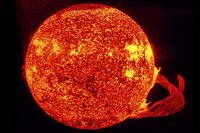
Procyon A is a yellowish star that is brighter
than our Sun, Sol. (See a 2MASS Survey
image
of Procyon A from the NASA
Star
and Exoplanet Database.)
System Summary
The Procyon System is located about 11.5 light-years (ly) from our Sun, Sol -- slightly higher than HIPPARCOS' estimate of 11.4 ly (Girard et al, 2000). Procyon A, or Alpha Canis Minoris A, is the brightest and most centrally located naked-eye star (07:39:18.12+05:13:29.98, ICRS 2000.0) of Constellation Canis Minor (the Smaller Dog). Procyon is also the upper left member of the "Winter Triangle" of first magnitude stars, whose other components are Sirius (Alpha Canis Minoris) at lower left and Betelgeuse (Alpha Orionis) at right center (see also wide-field image from Astronomy Picture of the Day).

MOST,
CSA
Procyon is the
brightest star
in Canis Minor,
the Little Dog
(more).
Alpha Canis Minoris A has a close companion star B that is separated "on average" by only about 16 times the distance from the Earth to the Sun -- 14.9 astronomical units (AUs) of an orbital semi-major axis -- which is roughly the distance between Uranus and our Sun. Alpha Minoris B, the companion star, is a white dwarf, stellar remnant and is so dim that it cannot be perceived with the naked eye. After analyzing irregularities in the proper motion of Procyon which were first detected in 1840, Arthur Julius Georg Friedrich von Auswers (1838-1915) deduced the presence of this faint but massive companion and published a computed period of 40 years in 1861. However, Procyon B was not detected visually until 1896 by John Martin Schaeberle (1853-1924) with the 36-inch refractor at Lick Observatory. There is a third optical companion C.
---------------------------------------------- [Guide] -- [Larger] ----------------------------------------------
| Orbital Distance (a=AUs) | Orbital Period (P=years) | Orbital Eccentricity (e) | Orbital Inclination (i=degrees) | Mass (Solar) | Diameter (Solar) | Density (Earths) | Surface Gravity (Earths) | Metallicity (Solar) | |
| AB Mass Center | 0.0 | ... | ... | ... | ... | ... | ... | ... | ... |
|---|---|---|---|---|---|---|---|---|---|
| Procyon A | 4.3 | 40.8 | 0.407 | 31.1 | 1.50 | 1.4-2.3 | ... | ... | 1.4 |
| Inner H.Z. Edge? | 2.0 | 2.28 | 0 | 31.1 | ... | ... | ... | ... | ... |
| Outer H.Z. Edge? | 4.0 | 6.54 | 0 | 31.1 | ... | ... | ... | ... | ... |
| Procyon B | 10.7 | 40.8 | 0.407 | 31.1 | 0.60 | 0.02 | ... | ... | 1.4 |
Procyon A
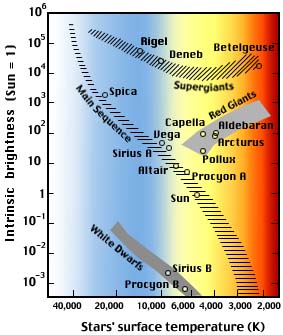
Alpha Canis Minoris A, the Little Dog Star, is the eighth brightest star in the night sky as well as the brightest star in its constellation. Unlike Sol, it is a white-yellow main sequence dwarf star of spectral and luminosity type F5 IV-V (Mosser et al, 2008). This relatively large star has about 1.5 times Sol's mass (Girard et al, 2000) and about 1.4 to 2.3 times its diameter (0.00510 to 0.00550", according to the Yale Bright Star Catalogue, 1991 5th Revised Edition notes entry for HR 2943; but while a diameter of 1.96 has been derived using a power law formula for the NASA Star Exoplanet Database from Kenneth R. Lang, 1980), more recent seismology data is consistent with an evolutionary model that assumes 2.04 of Sol's diameter (Leccia et al, 2007). Compared to Sol, moreover, Procyon A is hotter and about 7.5 times brighter. Procyon radiates somewhat more in ultraviolet wavelengths than Sol, and, not surprisingly, the European Space Agency has used ultraviolet spectral flux distribution data to determine stellar effective temperatures and surface gravities, including those of Procyon.

USAF
AMOS, Maui, Hawaii
Procyon at a resolution of 0.2
arc-seconds (larger
image).
Procyon A appears to be a relatively young star with only around 1.8 billion years (Leccia et al, 2007; Kenneth Croswell, 2005; and Eggenburger et al, 2005). However, being so much bigger and hotter Sol, the star will exhaust its core hydrogen within even the 4.6 billion years of Sol's current age and turn into a red giant before puffing away its outer layers to reveal a remnant core as a white dwarf. Indeed, Procyon A is unusually bright for its spectral type and so may be becoming a subgiant star that is beginning to evolve off the main sequence, as it begins to fuse the increasing amounts of helium "ash" mixed with hydrogen at its core. Analysis of "soft x-ray" emissions from Silicon ions indicate that Procyon's coronae is cooler than Sol's (Liang and Zhao, 2008).
NASA Observatorium
See a discussion of
the
"main
sequence"
as part of
stellar
evolution and death.
Many astronomers believe that the star has entered the last phase of its life and is becoming dimmer. As a result of studies conducted on the oscillation of our Sun, Sol, Procyon A should be oscillating in a certain pattern. When the Canadian Space Agency's MOST satellite monitored Procyon A for 32 consecutive days from January to February 2004 and in 2005, no oscillations were detected although the aging star should have vibrated and oscillated at a greater amplitude than Sol. As a result, models based on observations of Sol, for measuring stellar (p-mode) oscillations due to "turbulent convection" of its outer layers are being reexamined (UBC press release; and Guenther et al, 2007). In 2008, its oscillations were measured and found to have "a plateau of excess power ... [that] is broader than has been seen for other stars", and there is also "a slow variation in the radial velocity of Procyon ... [which] are remarkably similar to those seen in the Sun, and we interpret them as being due to rotational modulation from active regions on the stellar surface ... [with] a period of about 10 days" (Arentoft et al, 2008).
The star is rich in elements heavier than hydrogen ("metals rich"), as it has about 1.4 times the iron abundance of Sol, and dust has been detected in the system (Kuchner and Brown, 2000 -- in postscript). It was probably enriched by its companion star, which was once bigger and hotter than Procyon A and so evolved and "burnt out" even faster. Procyon B manufactured lots of heavier elements which it puffed out into space and onto Procyon A before becoming a white dwarf.

H. Bond (STSci),
R. Ciardullo (PSU), WFPC2, HST, NASA
(Procyon B is a white dwarf, a remnant stellar core, which enriched Procyon A
with elements
heavier than hydrogen when it cast off its outer gas layers,
like planetary nebula NGC
2440)
Procyon A is a BY Draconis-type variable star. Not only can its companion boost its brightness when located in front of the star as observed from Earth, but its intrinsic brightness actually varies as well. In addition to its New Suspect Variable (NVS) designation of NVS 3672, some other useful names and star catalogue numbers include: Alp or Alf CMi, 10 CMi, HR 2943, Gl 280 A, Hip 37279, HD 61421, BD+05 1739, SAO 115756, FK5 291, LHS 233, and ADS 6251 A.
Previous estimates of the orbital elements of this binary system calculated by Irwin et al in 1992 and by Kaj Aage Gunnar Strand (1907-2000; obit) in 1951 have been superceded. Based on new measurements (Girard et al, 2000) found in the new Sixth Catalog of Visual Orbits of Binary Stars, Procyon A and B may be separated on average by a semi-major axis of 14.9 AUs (4.271") in an elliptical orbit (e= 0.407) that takes 40.82 years to complete. The distance separating the two stars varies from 8.9 and 21.0 AUs; they are always separated from each other by roughly the orbital distance of Saturn in the Solar System. Lastly, the inclination of the orbit is 31.1°, from the perspective of an observer on Earth. (See a larger, interactive animation of the orbits of Stars A and B and their potentially habitable zones.)
Disrupted Habitable Zone around Star A?
According to one type of model calculations performed for the NASA Star and Exoplanet Database, the inner edge of Procyon A's habitable zone is located relatively far from the star at around 1.981 AUs from the star, while the outer edge lies even farther out at around 4.003 AUs. The distance from Procyon A where an Earth-type planet would be "comfortable" with liquid water is centered around 3.0 AUs (about the middle of the main asteriod belt in the Solar System between Mars and Jupiter), where its orbit period would be 4.2 years long. If there is life on any Earth-type planet orbiting Procyon A, it is likely to be primitive single-cell bacteria under major bombardment by meteorites and comets as Earth was for the first few billion years. If oxygen-producing microbes have not yet had time to develop and generate free oxygen in the atmosphere of such a planet, it probably would not have an ozone layer (O3) although Procyon A puts out more ultraviolet radiation than Sol. (For an illustrated discussion, see Christoph Kulmann's web page on the potential habitable zone around Procyon A.)
This much dimmer star is a white dwarf (DQZ,A4 or QZ,A4 VII), whose close proximity and large disparity in brightness with its primary have made precise determination of its luminosity, colors, and spectrum difficult (Irwin et al, 1992). At least 15,000 times fainter than Procyon A, it is also only 6/10,000th as luminous as Sol. Procyon B appears to have 60.2 percent of Sol's mass (Girard et al, 2000) but only about two percent of its diameter. In fact, its diameter may be no more than about 17,000 km (about 10,500 miles), which is only about 30 percent more than Earth's. On the other hand, white dwarfs are incredibly dense objects because they squeeze a stellar mass into a planetary volume, and so Procyon B's average density is estimated to be over two tons to the cubic inch.

NASA Observatorium
See a discussion of
the
"main
sequence"
as part of
stellar
evolution and death.
While tiny compared to main sequence stars, white dwarf stars are actually intensely hot, but without the internal heat of fusion to keep them burning, they gradually cool, redden, and fade away. As some star catalogues note that Star B actually appears yellowish, it is likely that this "white" dwarf is been cooling for a very long time and is much older than Sirius B. Useful star catalogue numbers for this Procyon B include Gl 280 B and ADS 6251 B.
Hunt for Substellar Companions
A search for faint companions using the Hubble Space Telescope from 1995 to 1999 found no supporting evidence for a large Jupiter or brown dwarf sized object, although the observed positions of Procyon AB -- Gl 280 AB -- differed from published orbital elements (Schroeder et al, 2000).
Closest Neighbors
The following star systems are located within 10 light-years of Procyon AB.
------------------------------------- [Guide] -- [Full Near Star Map] -------------------------------------
| Star System | Spectra & Luminosity | Distance (light-years) |
| Luyten's Star | M3.5-5 Ve | 1.2 |
| Ross 614 AB | M4.5 Ve ? | 4.6 |
| DX Cancri | M6.5 Ve | 5.0 |
| Sirius 2 | A0-1 Vm DA2.5/VII | 5.2 |
| LTT 12352 | M3.5 V | 5.3 |
| GJ 1116 AB | M5.5 V M5.5 V | 8.0 |
| Ross 882 AB | M4 Ve M5 Ve | 8.0 |
| Wolf 359 | M5.8 Ve | 8.6 |
| LTT 17993 | M4.5 V | 8.7 |
| LTT 17897 | M4 V | 8.8 |
| Lalande 21185 | M2.1 Ve | 9.6 |
| Wolf 294 | M3 V | 9.9 |
Other Information
Try Professor Jim Kaler's Stars site for other information about Procyon at the University of Illinois' Department of Astronomy. For another illustrated discussion, see Christoph Kulmann's web page on the potential habitable zone around Procyon A.
Up-to-date technical summaries on these stars can be found at: the Astronomiches Rechen-Institut at Heidelberg's ARICNS, the NASA Star and Exoplanet Database, and the Research Consortium on Nearby Stars (RECONS) list of the 100 Nearest Star Systems. Additional information may be available at Roger Wilcox's Internet Stellar Database.
The name Procyon was used by the Ancient Greeks, which the Romans translated into Latin equivalent as "Antecanis" or "Before the Dog" because Procyon rises immediately before Sirius, the "Dog Star." For more information about the stars and objects in this constellation, go to Christine Kronberg's Canis Minor. For an illustration, see David Haworth's Canis Minor.
For more information about stars including spectral and luminosity class codes, go to ChView's webpage on The Stars of the Milky Way.
© 1998-2011 Sol Company. All Rights Reserved. |