Uranus

Uranus |
|
|
| Home | Stars | Orbits | Habitability | Life | | |||
| | System Summary | Rocky Inner Planets | Main Asteroid Belt | Gas Giants | E-K Belt & Dust Disk | Oort Cloud | | |||
| | Sol | Mercury | Venus | Earth | Mars | Jupiter | Saturn | Uranus | Neptune | Dwarf Planets | Sol b? | |
NASA
-- larger,
sharper grey, and
more
images
Breaking News
Astronomers have revealed the discovery of a 60-kilometer (37-mile) wide Trojan asteroid, designated 2011 QF99, in the Lagrange points ahead of the Uranus' orbit at L4. As Jupiter is so massive that it should have grabbed Trojan asteroids around Uranus as the Solar System formed, the newly discovered Trojan may be a temporary companion relatively late in the planet's history. 2011 QF99 "should jitter around" L4 around 70,000 years before its orbit becomes unstable enough for it to be ejected (Jacob Aron, New Scientist, March 28, 2013; and Alexandersen et al, 2013).
The Planet
Uranus is the seventh planet from the Sun. It has four times the diameter of Earth at about 51,100 km (31,800 miles) but also 14.5 times Earth's mass. Although it takes about 84 years to orbit Sol at over 19 times the Earth-Sun distance, the giant planet completes a fast rotation in only 17 and a half hours. Unlike the other planets, its axis of rotation (obliquity lies mostly in the plane of the Solar System, as if some titanic collision had tipped the planet over on its side, but one theory suggests that its extreme tilt could have been created by a series of smaller shifts through orbital migrations and interactions between the giant planets during the earliest stages of Solar System formation (Adrián Brunini, 2006).
 Lawrence Sromovsky,
University of Wisconsin-Madison,
Keck
Observatory
Larger and
jumbo
near-infrared
false-color images.
The tilted planet's rings and
methane storm clouds have been
observed in near infrared
(more).
Compared to Jupiter and
Saturn, the planet's smaller mass and greater
distance from the Sun makes Uranus colder at the surface and less
internally active from the heat of gravitational compression. As a
result, it has a relatively bland appearance, although its dense
atmosphere is made of mostly molecular hydrogen (83 percent) and
helium (15 percent), with two percent methane and traces of acetylene
and other hydrocarbons -- similar to its larger neighbors. The
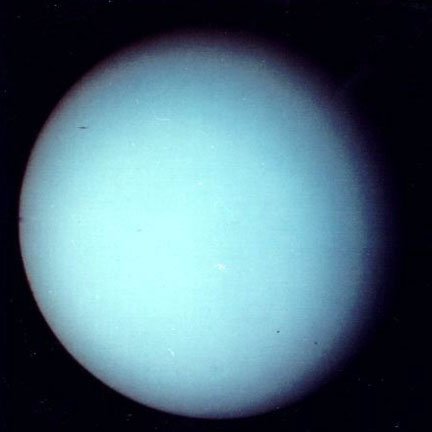
planet's greenish-blue color is due to light scattering as in Earth's
sky and the absorption of red light by its small amount of atmospheric
methane.

Courtesy Jet Propulsion Laboratory. Copyright (c) California
Institute of Technology, Pasadena, CA. All rights reserved.
While Uranus is called a gas giant, the planet's hydrogen envelope is far less massive than Jupiter and Saturn. Now also called a ice giant, Uranus is composed primarily of rock and various ices, with only about 15 percent hydrogen and a little helium overall, while Jupiter and Saturn are mostly hydrogen in gas and liquid metallic form. According to astronomer Richard Crowe, the planet may have a rock-ice core of about 1.2 times Earth's diameter -- 30 to 40 percent of Uranus' diameter -- and around 10 times Earth's mass -- 60 to 70 percent of Uranus' total mass ("Ask Astro", Astronomy, October 2004). However, Uranus does have a magnetic field that is tilted almost 60 degrees with respect to the axis of rotation and off center with respect to the planet (see schematic diagram comparing the axial tilts of Uranus and Earth). The field may be generated by internal movements at shallow depths compared to the other gas giants, but the original hypothesis of a layer of electrically conductive, ocean of water and ammonia lying under pressure between the heavy atmosphere and the core may have been disproven by recent findings.

Mark Showalter,
ESA, NASA --
larger
image and
fact
sheet
The planet has a set of
very
faint rings composed of black dust particles as
well as large boulders up to 10 meters
(or yards) across. One ring may have
been first observed in 1797 by astronomer by Sir
William
Herschel (1738-1822) due to a fortuitous
orientation of the ring and the planet
(more).
By 2005, 12 rings had been identified. (More on the latest
rings
and moons of Uranus and an
animation of the rings'
orbits and known satellites around Uranus,
with a table of basic orbital and physical characteristics.)
On August 23, 2007, astronomers using the Keck Observatory announced the results of new observations indicating that the rings of Uranus are much more dynamic than previously thought possible, able to vanish from existence as well as move thousands of kilometers or miles within a couple of decades (more discussion and images from UC Berkeley/Keck new release; ESO press release; and David Shiga, New Scientist, August 23, 2007).
 Keck
Observatory,
UC Berkeley
Keck
Observatory,
UC Berkeley
-- larger image
The rings of Uranus are changing
more rapidly than previously
thought possible
(more).
On April 7, 2006, astronomers using the Keck Telescope announced that the outermost ring is bluish from sub-micronsized ice particles reflecting sunlight. The ring inside the outermost blue ring, however, is more reddish -- as is the case with Saturn (press release and more information and images). Infrared observations suggest that the outermost More on the Uranian ring system is available from NASA's Planetary Rings Node.

Ann Feild,
ESA,
NASA
Larger image.
Uranus has 12
rings and 27
moons
(more).

VLT,
ESO
Larger near-infrared image.
A ringed Uranus with
seven of its 27 moons
labelled
(more).
All of five largest moons of Uranus are composed of a mix of about 40 to 50 percent water ice with rock. Miranda and Ariel orbit closest to the giant planet; Miranda is the smallest at 470 km (290 miles) in diameter with the innermost orbit, while Ariel is more than twice as big at 1,160 km (720 miles) and nearly the same size as Umbriel. Both, however, seem to share similar geologic contortions. The proximity of the two to Uranus may have subjected them to tidal forces that generated enough internal heat to cause partially melting and perhaps even volcanic eruptions and tectonic deformation in the distant past.

NASA (Five largest moons of Uranus, from left: Miranda,
Ariel, Umbriel, Titania, and Oberon)
Titania is the largest moon at 1,580 km (980 miles) across, but Oberon is nearly as big. Titania may have once been hot enough to be liquid, but its interior may have cooled after its surface already froze and so when the later expansion of internal freezing probably cracked its surface. Umbriel and Oberon are more heavily cratered, although Umbriel is darker and Oberon is about a third larger.
Unlike the other planets, Uranus' axis of rotation (obliquity lies mostly in the plane of the Solar System. Most theories suggest that one or more titanic collisions tipped the planet over on its side. One theory suggests, however, that its extreme tilt could have been created by a series of smaller shifts through orbital migrations and interactions between the giant planets during the earliest stages of Solar System formation (Adrián Brunini, 2006).
 NASA --
larger image
NASA --
larger image
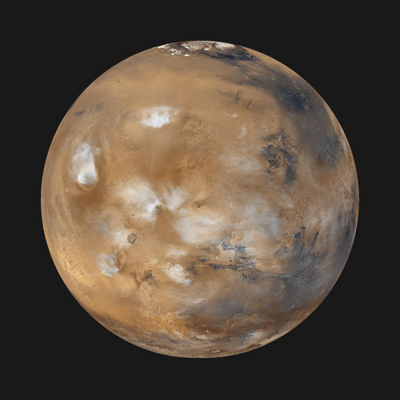
A large moon, more massive than
Mars (at left),
may have caused Uranus' odd tilt early during
the formation of the Solar System, before the
moon was ejected during the giant planets'
orbital migration around the Sun
(more).
On December 1, 2009, two astronomers submitted a pre-print suggesting that the planet's extreme axial tilt (an obliquity of 97 degrees) may have resulted from the presence of a large moon that has since been ejected from orbit around the ice giant by the pull of another planet during the orbital migration of the giant planets early in the formation of the Solar System. According to modelling simulations, the moon would need to have around one percent of Uranus' mass (somewhat greater than Mars) at a certain orbital distance from the planet to slightly unbalance the planet and increase its wobble about its axis which, after about two million years, could have become exaggerated enough to tip the planet on its side. After ejection, the moon could either have crashed into another Solar System object (like a neighboring gas giant) or been sent into an elongated orbit around the Sun like a comet or into interstellar space (Boué and Laskar, 2009; and Ker Than, New Scientist, December 4, 2009).
 Lawrence Sromovsky,
U. Wisconsin-Madison,
Lawrence Sromovsky,
U. Wisconsin-Madison,
Keck Observatory
Larger and
jumbo images.
Instead of one large impact, two smaller
impacts may hit hit the planet early during
the formation of the Solar System and
caused Uranus' odd tilt
(more).
On October 6, 2011, at the EPSC-DPS Joint Meeting, a team of planetary scientists presented the results of recent simulations which suggest that two or more smaller impacts instead of a single large impact by a large planetary object are more likely to have created the planet's extreme axial title. The scientists used simulations to generate different impact scenarios in order to ascertain the most likely cause of the planet's tilt. While a large impact on Uranus when it was still surrounded by a protoplanetary disk would have eventually produced moons in retrograde orbit around the planet, two or more smaller collisions had a much higher probability of generating the moons with the orbital direction observed today (Europlanet press release; and Phil Plait, Bad Astronomy Blog, Discover, October 7, 2011).
Astronomers have revealed the discovery of a 60-kilometer (37-mile) wide Trojan asteroid, designated 2011 QF99, in the Lagrange points ahead of the Uranus' orbit at L4. As Jupiter is so massive that it should have grabbed Trojan asteroids around Uranus as the Solar System formed, the newly discovered Trojan may be a temporary companion relatively late in the planet's history. 2011 QF99 "should jitter around" L4 around 70,000 years before its orbit becomes unstable enough for it to be ejected (Jacob Aron, New Scientist, March 28, 2013; and Alexandersen et al, 2013).
Other Information
More images of Uranus and its moons are available at NASA's Planetary Photojournal. Fact sheets on Uranus and its rings and moons are also available from NASA's National Space Science Data Center.
David Seal (a mission planner and engineer at NASA's Jet Propulsion Laboratory at CalTech) has a web site that generates simulated images of the Sun, planets, and major moons from different perspectives and at different times of the year. Click here to try his "Solar System Simulator."
For more information about the Solar System, go to William A. Arnett's website on "The Nine Planets", or to Calvin J. Hamilton's web page on "Uranus".
© 1998-2013 Sol Company. All Rights Reserved. |


