Epsilon Eridani

Epsilon Eridani |
|
|
| Home | Stars | Orbits | Habitability | Life | |

© Torben Krogh & Mogens Winther
(Amtsgymnasiet and EUC Syd Gallery,
student photo used with permission)
Epsilon Eridani is the bright star
at left center of meteor. (See a
2MASS Survey
image
of Epsilon
Eridani from the
NASA Star and
Exoplanet Database.)
System Summary
This star is located only about 10.5 light-years (ly) away in the northeastern part (03:32:55.84-09:27:29.74, ICRS 2000.0) of Constellation Eridanus, the River -- west of Rana (Delta Eridani) and northwest of Zaurak. Somewhat smaller and cooler than our own Sun, Sol, Epsilon Eridani is also less luminous. In Earth's night sky, however, it is clearly visible to the naked eye as the third closest star viewable without a telescope.

© James
B. Kaler, UIUC
(Photo from
Stars,
Planet Project,
and
Epsilon Eridani;
used with permission)
Epsilon Eridani appears to be a young system that is still rich in circumstellar icy and rocky debris and may possibly still be undergoing the final touches of planetary formation. In 1998, astronomers first revealed the first images of huge disk-like structures of dust around the star (press release -- more below). On August 7, 2000, astronomers announced the discovery (a possible confirmation of earlier detections) of a Jupiter-like planet around this Sun-like star (press release -- details below). On October 9, 2006, a team of astronomers (led by G. Fritz Benedict and Barbara E. McArthur) working with the Hubble Space Telescope announced "definitive evidence" for the existence of a Jupiter-class planet around Epsilon Eridani using astrometic measurements (NASA press release -- more below). On October 27, 2008 at the 5th Spitzer Conference on "New Light on Young Stars: Spitzer's View of Circumstellar Disks," a team of astronomers using NASA's two infrared cameras and an infrared spectrometer on the Spitzer Space Telescope revealed evidence that the Epilson Eridani system has two asteroid belts made of rocky and metallic debris left over from the early stages of planetary formation, as well as an icier cometary belt, and two more Jupiter-class planets (Spitzer press release -- more below).
 Medialab, © ESA
2002
Medialab, © ESA
2002
Larger illustration of
the
Darwin
Mission.
Astronomers have identified
Epsilon Eridani as a prime target
for NASA's optical SIM
and the
ESA's infrared
Darwin
missions,
now both indefinitely delayed.
Due to Epsilon Eridani's proximity to Sol, the star has been an object of high interest among astronomers. It was selected as a "Tier 1" target star for NASA's optical Space Interferometry Mission (SIM) to detect a planet as small as three Earth-masses within two AUs of its host star (and so some summary system information and images of Epsilon Eridani may still be available from the SIM Teams), but the SIM project manager announced on November 8, 2010 that the mission was indefinitely postponed due to withdrawal of NASA funding.
---------------------------------------------- [Guide] -- [Larger] ----------------------------------------------
| Orbital Distance (a=AUs) | Orbital Period (P=years) | Orbital Eccentricity (e) | Orbital Inclination (i=degrees) | Mass (Earths) | Diameter (Earths) | Density (Earths) | Surface Gravity (Earths) | Metallicity (Solar) | |
| Epsilon Eridani | 0.0 | ... | ... | ... | 280,000 | 81-98 | ... | ... | 0.49-0.65 |
|---|---|---|---|---|---|---|---|---|---|
| Inner H.Z. Edge? | 0.47 | 0.35 | 0.0 | ~25 | ... | ... | ... | ... | ... |
| Outer H.Z. Edge? | 0.91 | 0.95 | 0.0 | ~25 | ... | ... | ... | ... | ... |
| Inner Asteroid Belt | ~3 | ... | ... | ~25 | ... | ... | ... | ... | ... |
| Planet b or A | 3.39 | 6.85 | ~0.25 +/-0.23? | ~25 | 493 | ... | ... | ... | ... |
| Outer Asteroid Belt | <20 | ... | ... | ~25 | ... | ... | ... | ... | ... |
| Planet d or B? | ~20 | ~97 | ~0 | 25? | ~>300 | ... | ... | ... | ... |
| Planet c or C? | ~34 | ~220 | ~0 | 25? | ~>100 | ... | ... | ... | ... |
| Icy Cometary Belt | 35-90 | ... | ... | ~25 | 4,600-132,000 | ... | ... | ... | ... |
| Silicate "Halo" | 90-110 | ... | ... | ... | ... | ... | ... | ... | ... |
The Star
This main sequence, orange-red dwarf (K2 V) is a relative young star that is probably between 500 million to a billion years old, possibly around 850 million years old, based on angular diameter measurements and evolutionary models that are consistent with calcium II activity, lithium abundances, and gyrochronology (Backman et al, 2008; Benedict et al, 2006; and Saffe et al, 2005). It may have about 83 (+/- 0.05) to 85 percent of Sol's mass (Benedict et al, 2006; and RECONS), 74 to 84 percent of its diameter (Johnson and Wright, 1983, page 653; and NASA Star and Exoplanet Database, based the power law of formula in Kenneth R. Lang, 1980), but only about 33 to 34 percent of its bolometric luminosity (Saumon et al, 1996, Table 1; and NASA Star and Exoplanet Database, derived from the exponential formula of Kenneth R. Lang, 1980). The European Space Agency has used ultraviolet spectral flux distribution data to determine stellar effective temperatures and surface gravities, including those of Epsilon Eridani.
 INES,
LAEFF,
ESA
INES,
LAEFF,
ESA
Larger illustration.
Epsilon Eridani is a relatively
young main-sequence star,
that is smaller, redder, and
dimmer than Sol.
The star appears to be less enriched in elements heavier than hydrogen ("metals") because it has only 49 to 74 percent of Sol's abundance of iron (Santos et al, 2004; Laws et al, 2003; and Cayrel de Strobel et al, 1991, page 281). On the other hand, Epsilon Eridani has two asteroidal belts and a cold dust disk located at about where the Edgeworth-Kuiper (E-K) Belt of the Solar System would be -- from inside Neptune's orbit to twice Pluto's average distance from Sol. Moreover, there may also be as many as three Jupiter-class companions, which suggests that the metallicity determination formula for orange dwarfs may have to be adjusted as they have been for even less massive red dwarfs (Rojas-Ayala et al, 2010).
Epsilon Eridani is a chromospherically active star, whose spectral line shapes, magnetic field, and photospheric temperature vary much more over time than most main sequence stars (Gray and Baliunas, 1995). Because of its youth, the star spins relatively fast with a rotational period of 11 days (compared with Sol's 27-day rotation). This fast rotation generates the star's relatively strong magnetic field, which produces large starspots and its variable spectrum. The SIMBAD Astronomical Database identifies Epsilon Eridani as a BY Draconis-type variable. Some useful designations and catalogue numbers for this star are: Eps Eri, 18 Eri, HR 1084, Gl 144, Hip 16537, HD 22049, BD-09 697, SAO 130564, FK5 127, and LHS 1557.
The distance from Epsilon Eridani where an Earth-type rocky planet may have liquid water on its surface has been estimated to be between 0.47 and 0.91 AU (Jones and Sleep, 2003) -- between the orbital distances of Mercury and Earth in the Solar System. In that distance range from the star, such a planet would have an orbital period shorter an Earth year. According to alternative calculations performed for the NASA Star and Exoplanet Database, the inner edge of Epsilon Eridani's habitable zone could be slightly farther out from the star at around 0.507 AUs from the star, while the outer edge lies even farther out at around 1.005 AUs. Given the apparent youth of this star system, however, it is likely that only primitive, single-celled organisms like bacteria that can survive heavy meteorite or cometary bombardment would be likely to survive on any Earth-type planet that has cooled sufficiently to allow carbon-based lifeforms to develop. (For an illustrated discussion, see Christoph Kulmann's web page on the potential habitable zone around Epsilon Eridani.
Cold Dust Disk, Cometary Belt, and Icy Halo
British and American astronomers at the Joint Astronomy Center (JAC press release) in Hawaii, the University of California in Los Angeles (UCLA), and the Royal Observatory of Edinburgh obtained the first pictures of huge disk-like structures of dust around Epsilon Eridani in 1998. The structures resemble a younger version of the E-K Belt of icy objects (dormant comets and larger planetary bodies) that surround the Solar System. Although the pictures taken do not show the icy bodies directly, the dust that is shown is believed to be debris that is forming, or being fragmented from, these bodies as the result of collisions during the "late stages, or remnants, of the planet formation process" (Backman et al, 2008). If an astronomer could have seen what our Solar System looked like four billion years ago, then it would have looked very much as Epsilon Eridani looks today.

Submillimetre
Common-User Bolometer Array, James Clerk Maxwell Telescope, JAC
(Cold dust disk around Epsilon Eridani)
The "sub-millimeter" (sub-mm) image, above, shows emissions from tiny dust particles (that are only a fraction of a millimeter in size) in orbit around Epsilon Eridani. Yellow to red areas of the image indicate the highest concentrations of cold dust, while blue to black areas suggest very little dust. Most of the dust lies in a ring between 35 and 75 times the Earth to Sun distance (AU) around the star, peaking at a radius of about 60 AUs, with an estimated mass of about 0.014 to 0.4 Sol's mass. Subsequent observations and analysis at other wavelengths indicate that nearly all the of the sub-mm emissions from cold dust are confined to 35 to 70 AUs, and that the region beyond 90 AU was designated the "silicate halo," which the later Spitzer team speculated "could the result of collisions among planetesimals and fragments moving with modest departure from circular planar motions in the sub-mm ring" (Backman et al, 2008).
The ring structure (also "belt") may be a young analog to the E-K Belt of the Solar System, where the central region has been partially cleared by the aggregation of dust grains into planetesimals. There is much less dust in an apparent hole around the star at a distance within the radius of 's orbit, and the peak emissions found at 65 AU lies within a dust disk or ring of between 30 to 105 AUs radius, resulting from colliding bodies of five to nine Earth-masses. The dust disk appears to be inclined about 25° from Earth's line of sight. Epsilon Eridani itself is not seen because its small, hot surface emits very little in sub-millimeter wavelengths. (For further information, see Greaves et al, 2005; and Greaves et al, 1998). The prominent bright peak within the ring -- at the lower left -- may represent a concentration of dust particles trapped in mean-motion resonances by an orbiting planet (Liou and Zook, 1999), or (less likely) the remnants of a major cometary collision. Although there was no confirmation of a substellar companion around Epsilon Eridani at the time, this image indicated that at least one such object existed. Moreover, it is likely that the tiny dust particles around the star will gradually accumulate into icy bodies like those in the Solar System's E-K Belt.
The presence of planets around Epsilon Eridani is the most likely explanation for the depletion of dust within a radius of 35 AUs of the star because planets absorb such dust when they form. Moreover, past astrometric, doppler-shift, and radial-velocity analysis of perturbations ("wobbles") in the position of Epsilon Eridani -- by the late Peter van de Kamp (1901-1995) from 860 photographic plates made at Sproul Observatory in 1973 and by Bruce Campbell and others in 1988 -- suggested that a large planetary companion orbited this star (Lawton and Wright, 1990; and Campbell et al, 1988). That planetary candidate appeared to have less than five (perhaps three) times Jupiter's mass and to be orbiting at about 7.7 AU (between the orbits of Jupiter and Saturn in the Solar System) out from the star in an elliptical orbit (e= 0.5) with a period of about 25 years.
Further reinforcing the indirect evidence of a planetary system around this star was the observed substructure within the dust ring and other asymmetries in the ring itself, all of which could be due to perturbations by more than one substellar companion, including one just inside the dust ring at an orbital distance of 30 AU. Moreover, subssequent modelling of the asymmetric circumstellar disk around the star indicated that there is another planet with a fifth of Jupiter's mass at an orbital distance of about 55 to 65 AU from the star -- more than one and a half times the "average" orbital distance of Pluto in the Solar System (Gorkavyi et al, 2000; and (Liou and Zook, 1999).
The apparent hole in Epsilon Eridani's inner region contains about 1,000 times more dust than is found today in our Solar System's own inner region -- which would encompass the orbits of the planets from Mercury to Neptune. This implies that Epsilon Eridani's inner region may have about 1,000 times more cometary bodies than the Solar System's planetary region today. This interpretation is consistent with the early history of the Solar System, where heavy bombardment of the planets occurred during the System's first 600 million years although major impacts gradually tapered after about 3.5 billion years.
Asteroid Belts within the Cometary Ring (or Belt)
On October 27, 2008 at the 5th Spitzer Conference on
"New Light
on Young Stars: Spitzer's View of Circumstellar Disks,"
a team of astronomers (including
Dana
Backman,
Massimo
Marengo,
Karl
Stapelfeldt, K. Su, D. Wilner, C. D. Dowell, D. Watson,
J. Stansberry, G. Rieke, T. Megeath, G. Fazio, and
Michael
Werner)
using NASA's two infrared cameras and an infrared spectrometer on the
Spitzer
Space Telescope announced evidence (in the form of relatively
warm silicate dust grains) that the nearby star,
Epilson Eridani system has two relatively narrow, asteroid
belts made of rocky and metallic debris left over from the
early stages of planetary formation (NASA
press
release). The innermost debris belt is located roughly around
the same position as the
Main Asteroid Belt in the Solar
System and is rich in silicate
dust (Backman
et al, 2008), while the second, denser belt (which is
also mostly likely to be composed of bodies rich in rock
as well as ices) lies between the first belt and the broad,
outer ring (or belt) of icy bodies at 35 to 90 AUs out from
Epsilon Eridani that is similar to the Solar System's
Edgeworth-Kuiper Belt.
Planetary System
The detection of three differentiable circumstellar debris belts
around Epsilon Eridani suggest that the star hosts at least
three planets of significant mass. As least one Spitzer team
member also argued that smaller rocky planets can easily orbit
Epsilon Eridani in the warmer region within the innermost
asteroid belt, which would include the star's habitable zone
where liquid water on a planetary surface could be possible.
Astronomer
Alan
P. Boss, however, suspects that planet "b" (or "A")
is so close and massive that it may have sufficient
gravitational pull to disrupt the orbit of a planet in
the habitable zone (more discussion available from NASA
press
release;
Rachel
Courtland, New Scientist, October 27, 2008;
Dan
Vergano, USA Today, October 27, 2008; and
Backman et al,
2008). Subsequent infrared imaging failed to find
additional, cool Jupiter-class planets orbiting outside
the cometary ring or belt
(Marengo
et al, 2009).
Planet "b" or "A" -
One of the two possible planets previously detected around
Epsilon Eridani (planet "b" or "A" for the Spitzer team)
was discovered in 2000 and is thought to be
a Jupiter-class object in orbit around this nearby star at
an average distance of 3.4 AUs (or almost three and half
times Earth's orbital distance from the Sun), which is just
outside the innermost asteroid belt. Although some
researchers previously suggested that "Epsilon Eridani b"
moves in an exaggerated ellipse ranging between 1 and 5 AUs
around its host star, such an orbit would cross and quickly
disrupt and "clear out" the newly discovered innermost
asteroid belt; hence, the Spitzer team of astronomers argues
that planet b must have relatively circular orbit that keeps
it just outside the inner asteroid belt, such as the
eccentricity of e= 0.25 +/- 0.23 reported by
Butler
et al in 2006
(Backman et al, 2008).
In 2000, astronomers announced the discovery (or a possible
confirmation of earlier detections) of a
Jupiter-like planet around this Sun-like star
(press
release). A team of astronomers (including
Artie P. Hatzes,
Barbara McArthur, and
Diane B.
Paulson) led by
William
D. Cochran of the University of Texas McDonald Observatory
announced the discovery of this nearby extra-Solar planet around
Epsilon Eridani on August 7, 2000, at the
24th General
Assembly of the International
Astronomical Union in Manchester, England (United Kingdom).
The planet was initially estimated to have about 0.8 and 1.6 times the
mass of Jupiter (or 256 times the mass of Earth)
and an orbital distance from Epsilon Eridani of about 3.3 AUs -- within
the outer region of the Main Asteroid Belt in
the Solar System. (Subsequent astrometric measurements -- which were
superceded in 2006 -- suggested an actual mass of 1.2 (+/- 0.3) times
Jupiter's -- see
George
Gatewood, 2000). The planet was detected using six independent
data sets from competing planet search groups, taken with four telescopes
and using three different measurement techniques over more than two
decades. Work by
Sallie
L. Baliunas, an astronomer at the
Harvard-Smithsonian Center for
Astrophysics, helped to rule out alternative explanations for
the observed patterns in the data, such as violent fluctuations in the
young star. Past indications of a planetary companion around Epsilon
Eridani have been difficult to verify because the young star is
"jittery" with a very active chromosphere, and the high
chromospheric activity of the star made this planet detection less
certain than desirable at the time (see
summary of
debate at U.C. Berkeley).
On October 9, 2006, a team of astronomers
(led by G. Fritz
Benedict and Barbara E. McArthur) working with the
Hubble Space Telescope
announced "definitive evidence" for the existence of a Jupiter-class
planet around Epsilon Eridani using astrometic measurements combined
with those made at the University of Pittsburgh's
Allegheny Observatory (NASA
press
release). Combining astrometric with radial-velocity measurements
to determine the tilt of the planet's orbit, the astronomers were
able to estimate the "true mass" of planet b as about 1.55 +/- 0.24
times the mass of Jupiter. Located at an
average distance (semi-major axis) of 3.39 +/- 0.36 AUs from Epsilon
Eridani, the planet takes about 6.9 (6.85 +/- 0.03) years to complete
its highly eccentric orbit (e= 0.702 +/- 0.039). Approaching as
close as 2.4 and as far as 5.8 AUs from its host star, the planet's
orbit is also tilted about 30.1 +/- 3.8 degrees from Earth's line of
sight (Benedict et
al, 2006), but the 2008 Spitzer team believes that the orbit of
planet b (or A) is actually relatively circular given presence of the
innermost asteroid belt that it apparently is shepherding
(Backman et al, 2008;
and
Butler et al). Although
the planet's orbit takes it so far from
Epsilon Eridani that oceans on any moons would freeze, life could
potentially survive on a moon if it is massive enough to hold onto
a dense heat-trapping atmosphere like Saturn's
moon, Titan,
according to astronomer G.
Fritz Benedict. Astronomers had hoped to image the planet in 2007,
when its orbit would be closest to Epsilon Eridani and might have
reflected sufficient starlight for an image, but no images have been
made public, if taken.
Planet "d" or "B" -
Due to the discovery of a more massive, second asteroid belt
between the inner asteroid belt and the broad outer belt
of icy, comet-type bodies, the Spitzer team found persuasive
evidence for the presence of a third Jupiter-class, planetary
candidate ("c" or "B") at an average orbital distance of
roughly 20 AUs around Epsilon Eridani. The planet is
hypothesized to be "shepherding" icy rocky bodies at the
outer rim of the second asteroid belt (NASA
press
release). It probably has an orbital distance around
20 AUs and a period of roughly 97 years.
Planet "c" or "C" -
In 1998, a second planetary candidate (designated planet "C"
by the Spitzer team) was proposed to explain "lumpiness"
observed in the star's broad, outer belt of icy bodies (NASA
press
release). Estimated to be a few tenths of a Jupiter
mass, This planet should be located just inside the 35-AU
inner edge of the outermost belt of icier bodies (which
extends outward to 90 AUs or more from Epsilon Eridani)
at an orbital distance of around 34 AUs with a period
of roughly 220 years.
Astronomers
(Alice
C. Quillen and Stephen Thorndike) had previously announced
On October 24, 2002 that computer modelling of dust ring clumping
patterns (i.e., where the planet orbited a star three times for
every two times the dust orbited, or five times for every three
dust orbits) indicated the presence of a relatively smaller
planet with around a tenth of a Jupiter-mass -- around 30
Earth-masses. The planet moves around Epsilon Eridani at a
semi-major axis around 40 AUs. Tentatively named "c", the
planet was originally thought to have an eccentric orbit
(e~ 0.3) that takes around 280 years to complete
(Quillen
and Thorndike, 2002). (See an animation of the suspected
planetary orbits of this system,
with a table of basic orbital and physical characteristics. John
Whatmough also has illustrated web pages on this system in
Extrasolar
Visions.) Water Emissions -
In September of 2002, a team of astronomers (including Cristiano
Cosmovici of the Institute for Cosmic and Planetary Science)
announced at the
Second European
Workshop on Exo/Astrobiology that they had detected water
"maser" emissions from three of 17 star systems suspected of
hosting planets, including Epsilon Eridani, using the 32-meter
Medicina radio telescope near Bologna. These microwave emissions
could be generated from water molecules in a planet's atmosphere
when they are excited by the infrared light of its host star.
In an interview with
New
Scientist magazine, Astronomer Hugh Jones (Liverpool John
Moores University) noted that the water signals could be coming
from the host star rather than from a planetary atmosphere, but
that additional telescopic observation should be able to pinpoint
the exact source of the signal. Astronomer Geoff Marcy
(University of California at Berkeley) added that he would not
expect water maser emissions from the planets to be strong enough
to be detected from Earth, but noted: "It wouldn't be the first
time a surprising result came from extra-Solar planets." On
September 21, 27, and 28, 2002, however, P. Kondratko and J. Lovell
were unable to confirm the detection of water-maser emissions with
the 70-meter NASA Deep Space Network antenna (+ 400-MHz Smithsonian
and 16-MHz Australia Telescope correlation spectrometers) near
Canberra (More discussion at
Extrasolar
Planets Encyclopaedia).
 Tim Pyle,
Backman et al,
SSC,
CalTech,
JPL,
NASA
Larger illustration.
The recent detection of
two asteroid belts as
well as a broad, outer
belt of icy bodies
around Epsilon Eridani
indicates that the star
system has at least
three planets
(more).
 Tim Pyle?,
Backman et al,
SSC,
CalTech,
JPL,
NASA
Larger illustration.
While Epsilon Eridani
is somewhat less massive
than Sol, the younger
star has wider and more
massive belts of rocky
and icy bodies in orbit
with possible planets
in between them
(more).

© Lynette Cook (Artwork from
Extrasolar
Planets - Collection III, used with permission)
View from an icy moon of a ringed, planetary candidate "b," an inner
volcanic moon, and
zodiacal light and part of the dust ring around Epsilson Eridani, as
imagined by Cook

Greg Bacon,
Benedict
et al,
STScI,
ESA,
NASA
Larger illustration.
The Jupiter-class planet "b" or "A"
around Epsilon Eridani was confirmed
in 2006
(more).
 Greg Bacon,
Benedict
et al,
STScI,
ESA,
NASA
Larger illustration.
Planet "b"
moves around
Epsilon Eridani
within its dusk
disk at about
the same orbital
plane
(more).
 NASA,
Cassini-Huygens Mission
NASA,
Cassini-Huygens Mission
to Saturn and Titan
Larger
image.
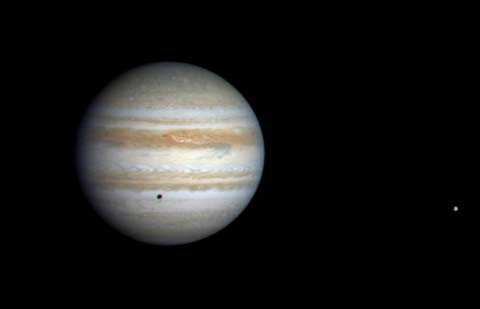
Like planetary candidate b ("A"),
"d" ("A" and "c" ("C") are estimated
were estimated to be massive
enough to be gas
giants, like
Jupiter
(shown here with Europa).

© Alice
C. Quillen and
Stephen Thorndike
(Used with permission)
Simulated image of clumping
within the dust disk around
Epsilon Eridani (star) and
hypothesized planet "c"
(black dot) --
more.
Closest Neighbors
The following star systems are located within 10 ly of Epsilon Eridani.
------------------------------------- [Guide] -- [Full Near Star Map] -------------------------------------
| Star System | Spectra & Luminosity | Distance (light-years) |
| Hip 15689 | ? | 4.1 |
| Luyten 726-8 | M5.6 Ve | 5.1 |
| Tau Ceti | G8 Vp | 5.5 |
| Teegarden's Star | M6.5 V | ~5.8 |
| Omicron2 Eridani 3 | K1 Ve DA4/VII M4.5 Ve | 6.4 |
| LHS 1565 | M5.5 V | 6.9 |
| YZ Ceti | M4.5 Ve | 7.0 |
| Sirius 2 | A0-1 Vm DA2-5/VII | 7.8 |
| L 1159-16 | M4.5 Ve | 8.0 |
| (LP 944-20) | brown dwarf | 8.3 |
| Kapteyn's Star | M0-1.5-3 VI | 8.5 |
| LP 656-38 | M3.5 V | 9.0 |
| Ross 614 AB | M4.5 Ve ? | 9.4 |
| Van Maanen's Star | DF-G/VII | 9.9 |
Other Information
Try Professor Jim Kaler's Stars site for other information about Epsilon Eridani at the University of Illinois' Department of Astronomy. The late John Whatmough also has illustrated web pages on this system in Extrasolar Visions. For another illustrated discussion, see Christoph Kulmann's web page on the potential habitable zone around Epsilon Eridani.
Up-to-date technical summaries on this star can be found at: Jean Schneider's Extrasolar Planets Encyclopaedia; the Astronomiches Rechen-Institut at Heidelberg's ARICNS, NASA's NASA Star and Exoplanet Database, the Research Consortium on Nearby Stars (RECONS) list of the 100 Nearest Star Systems, and the SIMBAD Astronomical Database. Additional information may be available at Roger Wilcox's Internet Stellar Database.
Eridanus, the river, wends its way from the Hunter's foot of Orion then southwest to the southern circumpolar zone to enclose a larger area of sky than any other constellation. Towards the western edge of Eridanus, is Gamma Eridani, which is also known as Zaurak. Epsilon Eridani is located northwest of Zaurak. For more information on stars and other objects in Constellation Eridanus and an illustration, go to Christine Kronberg's Eridanus. Another illustration is available at David Haworth's Eridanus.
For more information about stars including spectral and luminosity class codes, go to ChView's webpage on The Stars of the Milky Way.
© 1998-2011 Sol Company. All Rights Reserved. |