
© Adrian Mann (Artwork from
Starship
Daedalus, used with permission)
(For another illustration, see Joe Bergeron's
Daedalus
Starship)
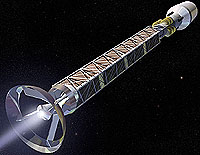
Project Daedalus was a 1973-77 study project of the
British Interplanetary
Society
to send an robotic, nuclear-powered spacecraft to
Barnard's Star, a very dim red
dwarf that may contain two Jupiter-class
planets. Accelerating to 12-13 percent of
light speed using a deuterium/helium-3 nuclear fusion reaction to
provide thrust,
Daedalus was designed to deliver a sensor platform and return data and images
while passing through Barnard's just 56 years after its departure from Earth.
For
more information, go to
Daedalus
Origins and Adrian Mann's
Starship Daedalus
pages which include color illustrations of the proposed interstellar spacecraft.
Interstellar : Sublight propulsion options and possible physics
Courtesy of
Laboratory for Elementary
Particle Science
at Pennsylvania State University and NASA
Matter-AntiMatter
rocket for interstellar missions,
or for moving heavy freight within the
Solar System.
Interplanetary : Chemical, electromagnetic, fusion, matter-antimatter, space sails, and tethers
NASA --
higher orbit image
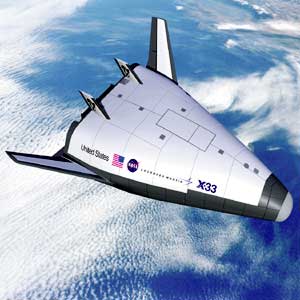
The wedge shaped
X-33
was being developed cooperatively
by NASA and Lockheed Martin Skunk Works. It was to be a
half-scale prototype of a Single-Stage-to-Orbit (SSTO)
Reusable Launch Vehicle (RLV) with two
linear
aerospike
engines that would fly at 15 times the speed of sound and
replace the Space Shuttle. On 3/1/2001, however, market
competition for intended commercial applications from
lower cost Russian, Chinese, and European rockets, as well
as a fuel tank design setback and cost-overruns, led NASA
to cancel the project despite good engine tests and near
completion (90 percent) of the hull. Efforts by the U.S. Air
Force to takeover X-33 funding for meeting its near-term
space deployment needs have been blocked repeatedly.
Planetary : Rockets, maglev- or beam-assisted RLVs, and space elevators or tethers
NASA
(Moon
tether)