Wolf 424 AB

Wolf 424 AB |
|
|
| Home | Stars | Orbits | Habitability | Life | |
NASA /
STScI
System Summary
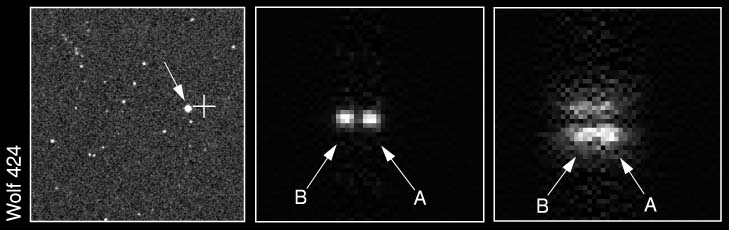
This extremely faint star system of two, very small and dim, red dwarf stars is located only about 14.2 light-years away. It lies in the north central part (17:33:17+09:01.3, ICRS 2000.0) of Constellation Virgo, the Maiden -- south of Vindemiatrix (Epsilon Virginis) and north of Auva (Delta Virginis). Wolf 424 A and B are not visible to the naked eye, either combined or individually, but the smaller companion star may be one of the most active (UV-Ceti type) Flare Stars -- Star B is designated FL Virginis -- known (Thomas J. Moffet, 1973) and so can brighten dramatically. The stars were discovered by Max (Maximilian Franz Joseph Cornelius) Wolf (1863-1932), a pioneer of astrophotography who discovered hundreds of variable stars and asteroids, and about 5,000 nebulae by analyzing photographic plates and developing the "dry plate" in 1880 and the "blink comparator" in 1900 with the Carl Zeiss optics company in Jena, Germany. Older calculations indicating that the Wolf 424 system would get as close to the Solar System as 0.95 light-years within around 7,500 years have been determined to be based on a "probably erroneous" radial velocity measurement (Vadim V. Bobylev, 2010; and Mülläri and Orlov, 1996).
 NASA -- larger image
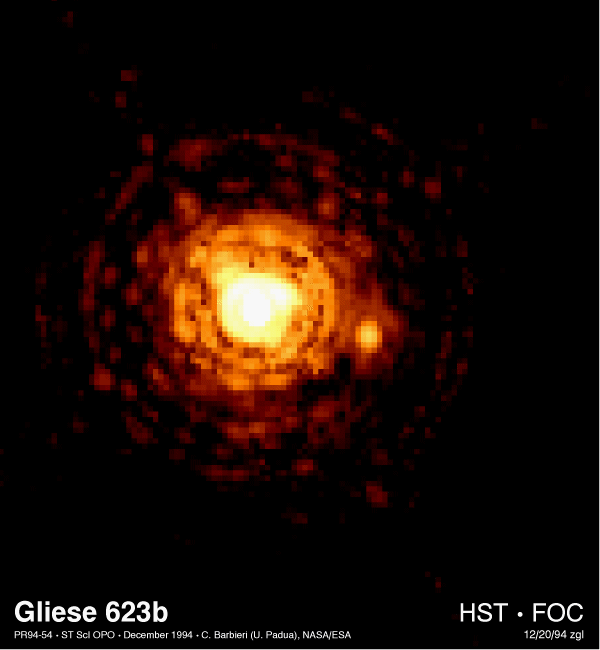
Wolf 424 AB are very dim, red dwarf stars, like Gliese
623 B (M5.8Ve) at lower right of Gl 623 A (M2.5V).
(A
2MASS
Survey
image
of Wolf 242 AB may become
available from the
NASA Star and
Exoplanet Database.)
AB Binary Star System
The two stars are separated "on average" by only 3.1 times the Earth-Sun distance -- 3.1 astronomical units (AUs) of an orbital semi-major axis (a= 0.715 +/-0.04"). However, the pair travel in an eccentric orbit (e= 0.28) around each other, and so their separation actually varies between 2.6 and 4.2 AUs in an orbit that takes 16.2 years to complete. The inclination of the orbit from the perspective of an observer on Earth is 103° (Wulff Dieter Heintz, 1989).
---------------------------------------------- [Guide] -- [Larger] ----------------------------------------------
| Orbital Distance (a=AUs) | Orbital Period (P=years) | Orbital Eccentricity (e) | Orbital Inclination (i=degrees) | Mass (Solar) | Diameter (Solar) | Density (Earths) | Surface Gravity (Earths) | Metallicity (Solar) | |
| AB Mass Center | 0.0 | ... | ... | ... | ... | ... | ... | ... | ... |
|---|---|---|---|---|---|---|---|---|---|
| Wolf 424 A | 1.5 | 16.2 | 0.28 | 103 | 0.12-0.14 | 0.17 | ... | ... | ... |
| Inner H.Z. Edge A | 0.022 | 0.009 | 0 | 103 | ... | ... | ... | ... | ... |
| Outer H.Z. Edge A | 0.054 | 0.035 | 0 | 103 | ... | ... | ... | ... | ... |
| Wolf 424 B | 1.6 | 16.2 | 0.28 | 103 | 0.12-0.13 | 0.14 | ... | ... | ... |
| Inner H.Z. Edge B | 0.02 | 0.008 | 0 | 103 | ... | ... | ... | ... | ... |
| Outer H.Z. Edge B | 0.05 | 0.031 | 0 | 103 | ... | ... | ... | ... | ... |
This very cool, main sequence red dwarf (M5.5Ve) is one of our Sun's dimmest stellar neighbors within 15 ly, with only 14/100,000th of Sol's visual luminosity. If our Sun, Sol, were replaced by Wolf 424 A, then an observer on Earth would need a telescope to see its round shape clearly, and daylight would be very dim with not much more than ten times the brightness of full moonlight with Sol. The star is now believed to have 12 to 14 percent of Sol's mass (Delfosse et al, 2000; RECONS; Torres et al, 1999; and NASA Star and Exoplanet Database, interpolated from McCarthy and Henry, 1993), with less than 17 percent of its diameter. Some useful star catalogue numbers are: Gl 473 A, G 12-43, G 60-14, LHS 333, LTT 13546, and LFT 923.
Jeffrey L. Linsky,
JILA,
STScI, NASA
Larger image.
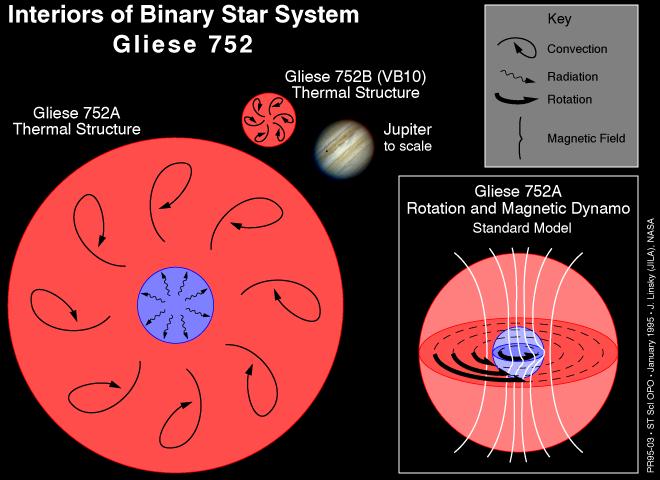
Wolf 424 AB have less
than 20 percent of Sol's
mass and so can
transport core heat
through convection only,
like Gliese 752 B
(more).
With a spectral type of M5.5, Proxima Centauri can be used as a rough proxy for Wolf 424 A (M5 V). Accounting for infrared radiation, the distance from Proxima where an Earth-type planet could have liquid water on its surface is around 0.022 to 0.054 AU (Endl and Kürster, 2008; and Endl et al, 2003, in pdf) -- much closer than Mercury's orbital distance of about 0.4 AU from Sol -- with a corresponding orbital period of 3.6 to 13.8 days (Endl and Kürster, 2008), while the NASA Star and Exoplanet Database has calculated a slightly farther out habitable zone between 0.033 and 0.064 AUs around Proxima. In any case, the rotation of such a close-orbiting planet would probably be tidally locked so that one side would be in perpetual daylight and the other in darkness and be subject to relatively frequent, large flares. Moreover, the light emitted by red dwarfs may be too red in color for Earth-type plant life to perform photosynthesis efficiently.
The companion star is a very cool, main sequence red dwarf (M5.5 or M7 Ve). It has about 12 to 13 percent of Sol's mass (Delfosse et al, 2000; RECONS; Torres et al, 1999; and NASA Star and Exoplanet Database, interpolated from McCarthy and Henry, 1993), with about 14 percent of its diameter but only 8/100,000th of its luminosity. Some of the star's dimness is probably due to sunspots which often lead to stellar flaring. Indeed, Wolf 424 B is a Flare Star (that has been designated with the variable star name FL Virginis) and so can brighten dramatically from time to time. Useful star catalogue numbers and designations include: FL Vir, Gl 473 B, G 236-65 B, and LHS 333 B.
 Arnold
O. Benz,
Institute
of Astronomy,
ETH Zurich
Arnold
O. Benz,
Institute
of Astronomy,
ETH Zurich
High resolution and
jumbo images
(Benz
et al, 1998).
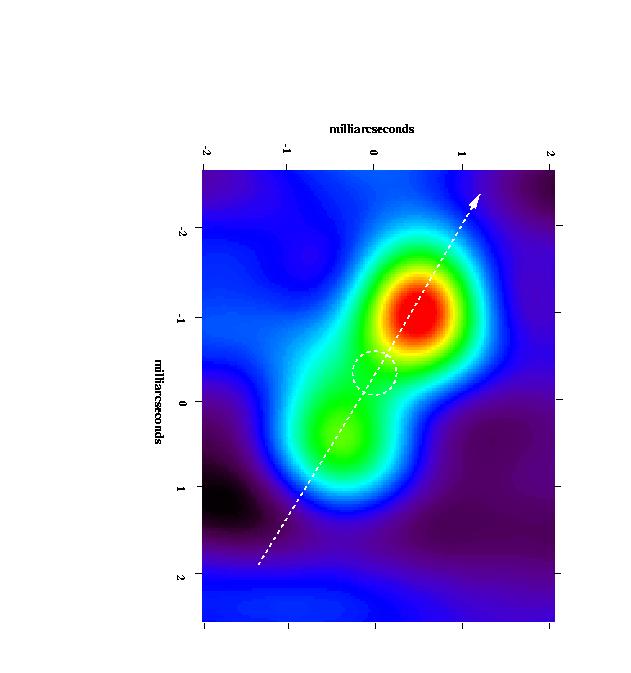
Wolf 424 B is a flare star, like UV
Ceti (Luyten 726-8 B)
shown flaring at left. UV Ceti is an extreme example
of a flare star that can boost its brightness by five times
in less than a minute, then fall somewhat slower back
down to normal luminosity within two or three minutes
before flaring suddenly again after several hours.
With a spectral type of M5.5, Proxima Centauri can be used as a rough proxy for Wolf 424 B (M5.5-7 V). Accounting for infrared radiation, the distance from Proxima where an Earth-type planet could have liquid water on its surface is around 0.022 to 0.054 AU (Endl and Kürster, 2008; and Endl et al, 2003, in pdf) -- much closer than Mercury's orbital distance of about 0.4 AU from Sol -- with a corresponding orbital period of 3.6 to 13.8 days (Endl and Kürster, 2008), while the NASA Star and Exoplanet Database has calculated a slightly farther out habitable zone between 0.033 and 0.064 AUs around Proxima. In any case, the rotation of such a close-orbiting planet would probably be tidally locked so that one side would be in perpetual daylight and the other in darkness and be subject to relatively frequent, large flares (as Wolf 424 B is a known and very active "flare star"). Moreover, the light emitted by red dwarfs may be too red in color for Earth-type plant life to perform photosynthesis efficiently.
Hunt for Substellar Companions
Images taken with the Hubble Space Telescope's Faint Object Spectrograph in 1996 offered some evidence to support earlier indications that either star could be a high-mass brown dwarf (Schultz et al, 1999). Subsequently, new measurements of the relative positions of the components of Wolf 424 AB (made with the Fine Guidance Sensors of the Hubble Space Telescope in 1996), however, indicated that both are actually low-mass red dwarf stars (Torres et al, 1999). Subsequent searches employing spectrophotometry and a coronographic survey also failed to find other companion objects (Oetiker et al, 2001; and Oppenheimer et al, 2001).
Life Around a Flare Star
Many dim, red (M) dwarf stars exhibit unusually violent flare activity for their size and brightness. These flare stars are actually common because red dwarfs make up more than half of all stars in our galaxy. Although flares do occur on our Sun every so often, the amount of energy released in a solar flare is small compared to the total amount of energy Sol produces. However, a flare the size of a Solar flare occurring on a red dwarf star (such as Wolf 424 B) that is more than ten thousand times dimmer than our Sun would emit about as much or more light as the red dwarf itself, doubling its brightness or more.
Flare stars erupt sporadically, with successive flares spaced anywhere from an hour to a few days apart. A flare only takes a a few minutes to reach peak brightness, and more than one flare can occur at a time. Moreover, in addition to bursts of light and radio waves, flares on dim red dwarfs may emit up to 10,000 times as many X-rays as a comparably-sized solar flare on our own Sun, and so flares would be lethal to Earth-type life on planets near the flare star. Hence, Earth-type life around flare stars may be unlikely because their planets must be located very close to dim red dwarfs to be warmed sufficiently by star light to have liquid water (between 0.02 and 0.05 AU for Wolf 424 A and B with an orbital period in 3 and 12 days), which makes flares even more dangerous around such stars. In any case, the light emitted by red dwarfs may be too red in color for Earth-type plant life to perform photosynthesis efficiently.
Closest Neighbors
The following star systems are located within 10 ly of Wolf 424 AB.
------------------------------------- [Guide] -- [Full Near Star Map] -------------------------------------
| Star System | Spectra & Luminosity | Distance (light-years) |
| Ross 128 | M4.1-5 Ve | 4.0 |
| EE Leonis | M4 Ve | 7.2 |
| Lalande 25372 | M1.5 Ve | 7.2 |
| G 12-30 | M5 Ve | 7.3 |
| Wolf 359 | M5.8 V | 7.3 |
| LP 731-58 | M6.5 V | 7.4 |
| AD Leonis | M3 Ve | 8.1 |
| Lalande 21185 | M2.1 Vne | 8.2 |
| LP 378-541 | M2 V | 8.4 |
| BD+44 2051 AB | M1 Ve M5.5Ve | 9.7 |
Other Information
Up-to-date technical summaries on this star can be found at: the Astronomiches Rechen-Institut at Heidelberg's ARICNS, the NASA Star and Exoplanet Database for Star A and B, and the Research Consortium on Nearby Stars (RECONS) list of the 100 Nearest Star Systems. Additional information may be available at Roger Wilcox's Internet Stellar Database.
Translated into Latin by the Romans from the Greek Goddess Demeter, the Earth-Goddess, Virgo is associated with the arrival of spring and bringer of the growing season. For more information about the stars and objects in this constellation and an illustration, go to Christine Kronberg's Virgo. For another illustration, see David Haworth's Virgo, where Vindemiatrix (Epsilon Virginis) is mislabelled as Zaniah (Eta Virginis).
For more information about stars including spectral and luminosity class codes, go to ChView's webpage on The Stars of the Milky Way.
© 1998-2011 Sol Company. All Rights Reserved. |

