61 Virginis

61 Virginis |
|
|
| Home | Stars | Habitability | Life | |
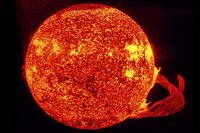
NASA
61 Virginis is a yellow-orange star
like our Sun, Sol.
(See a 2MASS
Survey
image
of 61 Virginis from
the
NASA Star
and Exoplanet
Database.)
System Summary
61 Virginis is located about 27.8 light-years from Sol. It lies at the southern edge (13:18:24.31-18:18:40.31, ICRS 2000.0) of Constellation Virgo, the Maiden -- southwest of the bright type-B binary Spica (Alpha Virginis). It is visible to unaided Human eyes under a dark sky (particularly during the Spring in the northern hemisphere). 61 Virginis has become one of the top 100 target stars for NASA's planned Terrestrial Planet Finder (TPF).
 Steven Vogt,
UCSC,
Larger map.
61 Virginis
is located
southwest of
the bright
type-B binary
Spica,
Alpha
Virginis, in
Constellation
Virgo
(more).
On December 14, 2009, a team of astronomers announced the discovery of one super-Earth and two Neptune-class planets (with at least 5, 18, and 24 Earth-masses, respectively) in moderately circular, inner orbits around 61 Virginis with periods of 4.2, 38.0, and 124.0 days (U.C. Santa Cruz news release; AAO press release; Keck press release; the Lick-Carnegie Exoplanet Survey Team's "Systemic Console;" and Vogt et al, 2009 -- more below). The super-Earth is one of the first two found around a spectral type G star, like our Sun, Sol. According to astronomers working with the Spitzer Space Telescope, a thick belt of dust (that is probably being generated by collisions between Edgeworth-Kuiper-Belt-type, icy objects) lies some 96 to 195 AUs out from the star (Bryden et al, 2009; Tanner et al, 2009, see HD 115617; and Vogt et al, 2009 -- more below).
---------------------------------------------- [Guide] -- [Larger] ----------------------------------------------
| Orbital Distance (a=AUs) | Orbital Period (P=years) | Orbital Eccentricity (e) | Orbital Inclination (i=degrees) | Mass (Earths) | Diameter (Earths) | Density (Earths) | Surface Gravity (Earths) | Metallicity (Solar) | |
| 61 Vir | 0.0 | ... | ... | ... | 314,000 | 105 | ... | ... | 1.1 |
|---|---|---|---|---|---|---|---|---|---|
| Planet "b" | 0.050 | 0.011 | 0.12 | ? | =>5.1 | >1 | ... | ... | ... |
| Planet "c" | 0.218 | 0.104 | 0.14 | ? | =>18.2 | >1 | ... | ... | ... |
| Planet "d" | 0.476 | 0.340 | 0.35 | ? | =>24.0 | >1 | ... | ... | ... |
| Inner H.Z. Edge | 0.764 | 0.685 | 0 | ? | ... | ... | ... | ... | ... |
| Outer H.Z. Edge | 1.520 | 1.923 | 0 | ? | ... | ... | ... | ... | ... |
| Inner Debris Orbit | 96 | 965 | 0 | ? | ... | ... | ... | ... | ... |
| Outer Debris Orbit | 195 | 1,793 | 0 | ? | ... | ... | ... | ... | ... |
61 Virginis is a yellow-orange main sequence dwarf of spectral and luminosity type G5-6 V, with about 92 to 96 percent of Sol's mass (95 percent using the isochrone mass estimate of Valenti and Fischer, 2005; and NASA Star and Exoplanet Database, based on David F. Gray, 1992), 94 to 98 percent of its diameter (96 percent for Valenti and Fischer, 2005; Johnson and Wright, 1983, page 677; and NASA Star and Exoplanet Database, derived from the exponential formula of Kenneth R. Lang, 1980), and around 78 percent of its visual luminosity and nearly 81 percent of its theoretical bolometric luminosity, with infrared radiation (Sousa et al, 2008; Valenti and Fischer, 2005; NASA Star and Exoplanet Database, based on Kenneth R. Lang, 1980). The star may be as much as 1.1 times as enriched as Sol with elements heavier than hydrogen ("metallicity"), based on its abundance of iron (NASA Star and Exoplanet Database from Valenti and Fischer, 2005; and Cayrel de Strobel et al, 1991, page 295). It appears to be "an old, inactive star" of 6.3 to 9.0 billion years in age (Vogt et al, 2009; Takeda et al, 2007; and Valenti and Fischer, 2005). Over 16 years of photometric observations indicate that 61 Virginis is photometically stable (Vogt et al, 2009). Useful star catalogue numbers for the star include: 61 Vir, HR 5019, Gl 506, Hip 64924, HD 115617, BD-17 3813, SAO 157844, FK5 1345, LHS 349, LTT 5111, LPM 467, LFT 990, and GC 18007.
 Sky View,
NASA
Sky View,
NASA
Larger false-color image.
61 Virginis is a little
smaller, less massive,
and dimmer than our
Sun, Sol.
According to one type of model calculations performed for the NASA Star and Exoplanet Database, the inner edge of 61 Vir's habitable zone should be located around 0.76 AU from the star, while the outer edge edge lies around 1.52 AUs. Hence, all of the known planets of 61 vir orbit withing the star's habitable zone's inner edge and so are presumed to be too hot to have liquid water on their surface. Astronomers are hoping that someday they will be able to use NASA's indefinitely postponed Terrestrial Planet Finder (TPF) and the ESA's Darwin similarly postponed groups of observatories to search for a rocky inner planet in the so-called "habitable zone" (HZ) around 61 Virginis. As proposed, the TPF will include two complementary observatory groups: a visible-light coronagraph; and a "formation-flying" infrared interferometer, while Darwin would launch a flotilla of three mid-infrared telescopes and a fourth communications hub. (See a larger animation of the planetary orbits, dust disk, and potentially habitable zone around 61 Virginis.)
According to astronomers working with the Spitzer Space Telescope, a thick belt of dust (that is probably being generated by collisions between Edgeworth-Kuiper-Belt-type, icy objects) lies some 96 ± 5 to 195 ± 10 AUs out from the star, assuming that the emitting bodies are black bodies (Bryden et al, 2009; Tanner et al, 2009, see HD 115617; and Vogt et al, 2009). Assuming that the infrared emissions are from from silicate grains at 0.25 micrometers, however, the disk would be located at an outer orbit of 120 ± 20 to 220 ± 10 AUs (Vogt et al, 2009). Cold dust particles have been detected at 160 micrometers (Tanner et al, 2009, see HD 115617). However, there has been previous detection of warmer but still cool, if relatively more luminous infrared excesses at 70 micrometers that is probably generated by dust located beyond 10 AUs from the star (Bryden et al, 2009; and Trilling et al, 2008).
Planetary System
As of December 14, 2009, the 61 Virginis system is known to have one super-Earth and two Neptune-class planets, as well as a circumstellar debris disk. Prior to 2009, small but significant variations in radial velocity had been detected which may have been caused by a substellar companion of one to nine Jupiter-masses with an orbital period of 50 years of less (Campbell et al, 1988, pages 904, 906, and 919). A subsequent radial velocity study also failed to detect a brown dwarf sized companion (with 20 to 80 times the mass of Jupiter) within 10 AUs of 61 Virginis (Murdoch et al, 1993). A few years later, even a brown dwarf or Jupiter- or Saturn-class planet in a inner orbit was discounted with further observations (Cumming et al, 1999).
 U. New South Wales,
Carnegie Institution/DTM,
Larger and
jumbo
illustrations.
Two
super-Earths
and a
Neptune-class planet
were discovered
around 61 Virginis
in 2009
(more).
Planets "b, c, and d" - On December 14, 2009, a team of astronomers (Steven S. Vogt; Robert A. Wittenmyer, R. Paul Butler, Simon O’Toole, Gregory W. Henry, Eugenio J. Rivera, Stefano Meschiari, Gregory Laughlin, C. G. Tinney, Hugh R. A. Jones, Jeremy Bailey, Brad D. Carter, and Konstantin Batygin) announced the discovery of one innermost orbiting super-Earth and two outer-orbiting, Neptune-class planets (with at least 5.1, 18.2, and 24.0 Earth-masses, respectively) in moderately circular, inner orbits around 61 Virginis with periods of 4.2, 38.0, and 124.0 days, based on radial-velocity observations over 4.6 years with the Keck Observatory's High Resolution Echelle Spectrometer (HIRES) and the Anglo-Australian Telescope (U.C. Santa Cruz news release; AAO press release; Keck press release; the Lick-Carnegie Exoplanet Survey Team's "Systemic Console;" and Vogt et al, 2009). The three planetary candidates "b", "c", and "d" orbit the star at semi-major axes of 0.050, 0.218, and 0.476 AUs, and Keplerian orbital solutions suggest eccentricities of 0.12, 0.14, and 0.35.
 Jonathan Langton,
Principia College
Larger
simulation slide
of atmospheric flows.
Planet "b" has an inner
"torch" orbit that should
heat its atmosphere so
much that it glows
(more).
Test simulations of the orbits of the three planets around 61 Virginis suggest that the planetary system's orbital configuration is dynamically stable because of low orbital eccentricities for at least 365 million years. However, the orbital configuration probably has been stable for much longer given the estimated system age of 6.3 to 9.0 billion years (Vogt et al, 2009). Within the 97-AU-radius debris disk, the discovery team believes that planets less massive than Jupiter could orbit undetected in outer orbits.
 JPL,
NASA
JPL,
NASA
Larger image.
While planet "c" could be
rocky, even more massive
planet "d" is probably
gaseous -- like
Neptune.
Closest Neighbors
The following star systems are located within 10 light-years, plus more bright stars within 10 to 20 ly, of 61 Virginis.
------------------------------------ [Guide] -- [Full Bright Star Map] ------------------------------------
| Star System | Spectra & Luminosity | Distance (light-years) |
| L 763-63 | K2 V | 4.6 |
| Ross 695 | M4 V | 6.4 |
| LP 734-32 | M V | 8.9 |
| * plus bright stars * | . . . | |
| Ross 948 AB | G V M2 V | 14 |
| HR 4523 AB | G2-5 V M4 V | 15 |
| Porrima 3 | F0 V F0 V ? | 15 |
| Zavijava A? | F8-9 V | 18 |
| HR 4587 | G8-K9 IV | 19 |
| Xi Bootis 2? | G8 Ve K4-5 Ve ? | 19 |
Other Information
Up-to-date technical summaries on these stars can be found at: Jean Schneider's Extrasolar Planets Encyclopaedia; the Astronomiches Rechen-Institut at Heidelberg's ARICNS, the NASA Star and Exoplanet Database, and the Research Consortium on Nearby Stars (RECONS). Additional information may be available at Roger Wilcox's Internet Stellar Database.
Translated into Latin by the Romans from the Greek Goddess Demeter, the Earth-Goddess, Virgo, is associated with the arrival of spring and bringer of the growing season. For more information about the stars and objects in this constellation and an illustration, go to Christine Kronberg's Virgo. For another illustration, see David Haworth's Virgo.
For more information about stars including spectral and luminosity class codes, go to ChView's webpage on The Stars of the Milky Way.
© 1998-2011 Sol Company. All Rights Reserved. |
