Ross 248

Ross 248 |
|
|
| Home | Stars | Habitability | Life | |
 NASA -- larger image
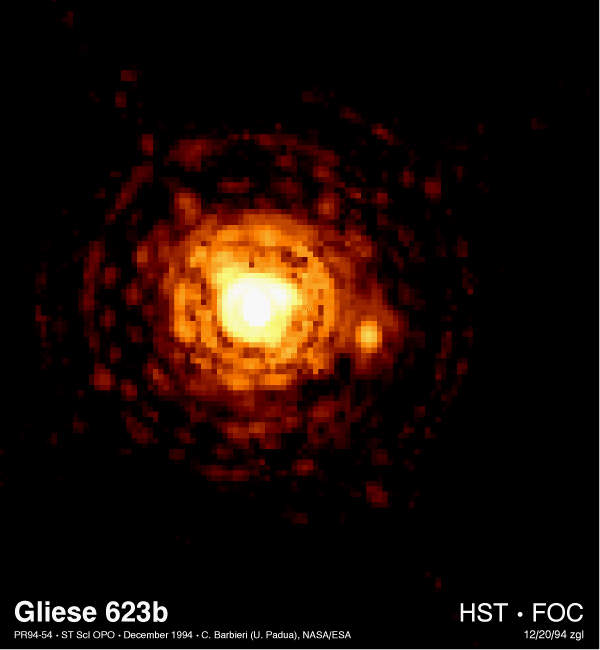
Ross 248 is a dim red dwarf star, like Gliese 623 A (M2.5V)
and B (M5.8Ve) at lower right. (See a
2MASS Survey
image
of Ross 248 from the
NASA Star and
Exoplanet Database
may eventually become available.)
System Summary
Ross 248 lies about 10.3 light-years (ly) away in the northwestern part (23:41:54.0+44:09:32:C~, ICRS 2000.0) of Constellation Andromeda, the Chained Maiden -- south of Lambda Andromedae and near Kappa and Iota Andromedae. It is too faint to be seen by the naked eye. The star was discovered in 1925 by Frank Elmore Ross (1874-1960), who also took the first good infrared and ultraviolet photographs of Venus in 1923. Ross first reported on this star in his "Second List of New Proper-Motion Stars," Astronomical Journal (36:856).
The Star
This cool and dim, main sequence red dwarf (M5.5 or 4.9 Ve) has around 12 of Sol's mass (RECONS), seven percent of its diameter, but only 11/100,000th of its luminosity. (Another reference, however, suggests seven percent of Sol's mass, 17 percent of its diameter, but the same luminosity). Ross 248 would be only one of many unremarkable stars except that it is one of Sol's closest neighbors. Classified as a "flare star," Ross w48 also has the variable designation HH Andromedae, and investigators have reported finding possible periods of variability at 4.2 years, 120 or 121 days, and five other periods between 60 and 291 days, which may be caused by an unresolved companion (Edward W. Weiss, 1993, page 1139). Useful catalogue numbers for Ross 248 include: HH And, Gl 905, G 171-10, G 190-42, LHS 549, LTT 16985, and LFT 1816.
 Jeffrey L. Linsky,
JILA,
STScI, NASA
Jeffrey L. Linsky,
JILA,
STScI, NASA
Larger image.
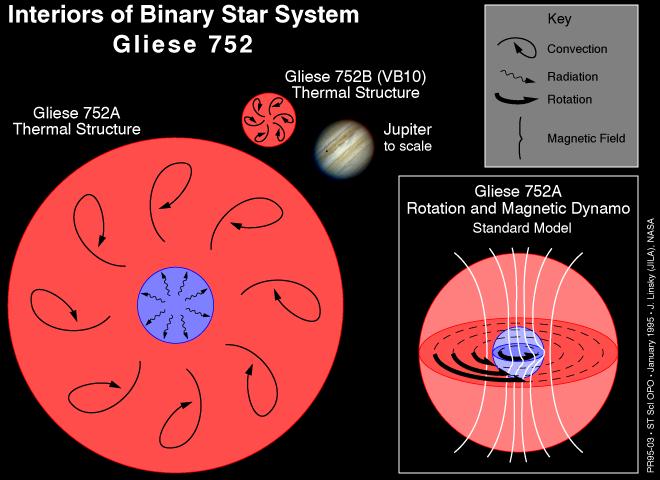
Like Gliese 752 B, Ross 248 is so small,
with less than 20 percent of Sol's mass,
that it can transport core heat only through
convection, unlike larger larger red dwarf
stars like Gliese 752 A
(more).
With a spectral type of M5.5, Proxima Centauri can be used as a rough proxy for Ross 248 (M5.5 or 4.9 Ve). Accounting for infrared radiation, the distance from Proxima where an Earth-type planet could have liquid water on its surface is around 0.022 to 0.054 AU (Endl and Kürster, 2008; and Endl et al, 2003, in pdf) -- much closer than Mercury's orbital distance of about 0.4 AU from Sol -- with a corresponding orbital period of 3.6 to 13.8 days (Endl and Kürster, 2008), while the NASA Star and Exoplanet Database has calculated a slightly farther out habitable zone between 0.033 and 0.064 AUs around Proxima. In any case, the rotation of such a close-orbiting planet would probably be tidally locked so that one side would be in perpetual daylight and the other in darkness and be subject to relatively frequent, large flares (as Ross 248 is a known "flare star"). Moreover, the light emitted by red dwarfs may be too red in color for Earth-type plant life to perform photosynthesis efficiently.
Hunt for Substellar Companions
There may have been an unconfirmed detection of a substellar companion around Ross 248 with an orbital period of eight years. In the late 1980s, a search using multiple, precise Doppler shift measurements for weak gravitational perturbations by companion objects as small as 20 times Jupiter's mass that are located within 10 AUs of Ross 248 was negative (Butler and Benitz, 1989). Moreover, a recent search for faint companions using the Hubble Space Telescope found no supporting evidence for a large Jupiter or brown dwarf sized object (Schroeder et al, 2000).
Closest Neighbors
The following star systems are located within 10 light-years of Ross 248.
------------------------------------- [Guide] -- [Full Near Star Map] -------------------------------------
| Star System | Spectra & Luminosity | Distance (light-years) |
| Groombridge 34 Aab,B | M3.3 V ? M3.8 Ve | 1.8 |
| Kruger 60 AB | M3 V M4 V | 4.5 |
| 61 Cygni 2 | M3.5-5.0 Ve M4.7-7.0 Ve | 5.6 |
| EV Lacertae | M3.5 Ve | 6.6 |
| Struve 2398 AB | M3.0 V M3.5 V | 8.5 |
| Van Maanen's Star | DF-G/VII | 9.5 |
| Teegarden's Star | M6.5 V | ~9.7 |
| L 1159-16 | M4.5 Ve | 9.9 |
Other Information
Up-to-date technical summaries on these stars can be found at: the Astronomiches Rechen-Institut at Heidelberg's ARICNS, the NASA Star and Exoplanet Database, the Research Consortium on Nearby Stars (RECONS) list of the 100 Nearest Star Systems, and the SIMBAD Astronomical Database. Additional information may be available at Roger Wilcox's Internet Stellar Database.
In Greek mythology, Andromeda was rescued from Cetus, the Whale, by Perseus who also married her. This constellation is most easily seen in Autumn for observers in the Northern Hemisphere, but may be visible from June through February. For more information about the stars and objects in this constellation and an illustration, go to Christine Kronberg's Andromeda. For another illustration, see David Haworth's Andromeda.
For more information about stars including spectral and luminosity class codes, go to ChView's webpage on The Stars of the Milky Way.
© 1998-2011 Sol Company. All Rights Reserved. |