Pi3 Orionis 2?

Pi3 Orionis 2? |
|
|
| Home | Stars | Habitability | Life | |
NASA
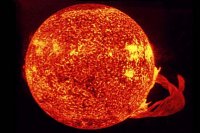
Pi3 Orionis A is a yellowish star that is
brighter than our Sun, Sol. (See a Digitized
Sky Survey
image
of Pi3 Orionis from the
NASA
Star and Exoplanet Database.)
System Summary
Also known as Tabit, this (possibly multiple) star system is located about 26.2 light-years (ly) away from our Sun, Sol. It lies at the western edge (04:49:50.41+06:57:40.59, ICRS 2000.0) of Constellation Orion, the Hunter -- southeast of Aldebaran (Alpha Tauri), south of Pi1 and Pi2 Orionis, and north of Pi4 Orionis. According to emeritus Profesor James B. Kaler in his Stars page on Tabit:
Pi3 Orionis came to within 15 light-years of Sol about 210,000 years ago. The star was identified one of the top 10 target stars for NASA's indefinitely postponed Terrestrial Planet Finder (James Kasting, 2010, page 352).
 JPL,
CalTech,
NASA
JPL,
CalTech,
NASA
Larger illustration
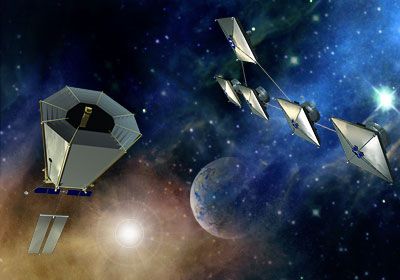
Astronomers have identified Pi3
Orionis as a Top 10 target for the
Terrestrial
Planet Finder (TPF),
now indefinitely postponed.
Pi3 Orionis
This star is a white-yellow main sequence dwarf star of spectral and luminosity type F6 V, with almost 1.3 times Sol's mass (NASA Star and Exoplanet Database; and David F. Gray, 1992), 1.2 5o 1.3 times its diameter (von Belle and von Braun, 2009, HD 30652 in Table 4, page 7; Perrin and Karoji, 1987; NASA Star and Exoplanet Database; and Kenneth R. Lang, 1980), and over 2.6 times of its bolometric luminosity (NASA Star and Exoplanet Database; and Kenneth R. Lang, 1980). It may be anywhere from 20 to 151 percent as enriched as Sol with elements heavier than hydrogen ("metallicity"), based on its abundance of iron (NASA Star and Exoplanet Database; and Cayrel de Strobel et al, 1991, page 10). With a rotational period of 3.9 days, Pi3 Orionis A may be around 1.4 to 2.2 billion years old (Lawler et al, 2009, HD 30652 in Table 1, page 24; Holmberg et al, 2009; and James B. Kaler, web page on Tabit).
An unconfirmed, Delta Scuti-type variable, the star has been designated as a New Suspected Variable (NSV) 1731. Star A has a probable optical companion (Abt and Levy, 1976, page 20) but may also have a spectroscopic companion that speckle interferometry has not been able to resolve (Hartkopf and McAlister, 1984). Useful star catalogue numbers for the star include: Pi3 Ori, 1 Ori, HR 1543*, Gl 178, Hip 22449, HD 30652, BD+06 762, SAO 112106, FK5 1134, and LTT 11517.
Pi3 Orionis B?
According to the Yale Bright Star Catalogue, 1991 5th Revised Edition notes entry for HR 1543, its visual companion may be optical.
Hunt for Substellar Companions
The distance from star A where an Earth-type planet would be "comfortable" with liquid water is centered around 1.7 AU -- beyond the orbital distance of Mars in the Solar System. Astronomers are hoping to use NASA's Terrestrial Planet Finder (TPF) and the ESA's Darwin planned groups of observatories to search for a rocky inner planet in the so-called "habitable zone" (HZ) around Pi3 Orionis. As originally planned but indefinitely postponed, the TPF would include two complementary observatory groups: a visible-light coronagraph; and a "formation-flying" infrared interferometer, while Darwin would include a flotilla of three mid-infrared telescopes and a fourth communications hub beginning in 2015.
Closest Neighbors
The following star systems are located within 10 light-years of Pi3 Orionis.
| Star System | Spectra & Luminosity | Distance (light-years) |
| Ross 41 | M3.5-5 V | 5.1 |
| BD-05 1123 AB | K3 V ? | 6.7 |
| G 99-47 | DA9 /VII | 7.3 |
| BD+18 683 | M2.5 Ve ? | 7.5 |
| LP 656-38 | M3.5 V | 8.3 |
| L 879-14 | DQ7 /VII | 8.6 |
| LP 415-636 | M4.5 Ve | 8.8 |
| Ross 47 | M4 V | 9.1 |
| G 99-44 | DZ9 /VII | 9.3 |
| LTT 11392 | M4 Ve | 9.4 |
| BD-03 1123 | M1.5 V | 9.5 |
| Chi1 Orionis3? | G0 V ? ? | 9.9 |
| LP 378-541 | M2 V | 9.3 |
Other Information
Try Professor Jim Kaler's Stars site for other information about Tabit at the University of Illinois' Department of Astronomy.
Up-to-date technical summaries on these stars can be found at: the Astronomiches Rechen-Institut at Heidelberg's ARICNS, the NASA Star and Exoplanet Database, and the Research Consortium on Nearby Stars (RECONS). Additional information may be available at Roger Wilcox's Internet Stellar Database.
Constellation Orion is easily visible in the Northern Hemisphere. In Greek mythology, Orion (the Great Hunter) died after being stung by by the scorpion (Constellation Scorpius). For more information about the stars and objects in this constellation and an illustration, go to Christine Kronberg's Orion. For another illustration, see David Haworth's Orion.
For more information about stars including spectral and luminosity class codes, go to ChView's webpage on The Stars of the Milky Way.
© 1998-2010 Sol Company. All Rights Reserved. |