Life Elsewhere?

Life Elsewhere? |
|
|
| Home | Stars | Orbits | Habitability | Life | | |||
| | Venus? | Mars? | Europa? | Elsewhere? | Earth | Alien Plants | |
 Unknown artist, Planet
Quest,
Unknown artist, Planet
Quest,
JPL,
Caltech,
NASA
Larger illustration.
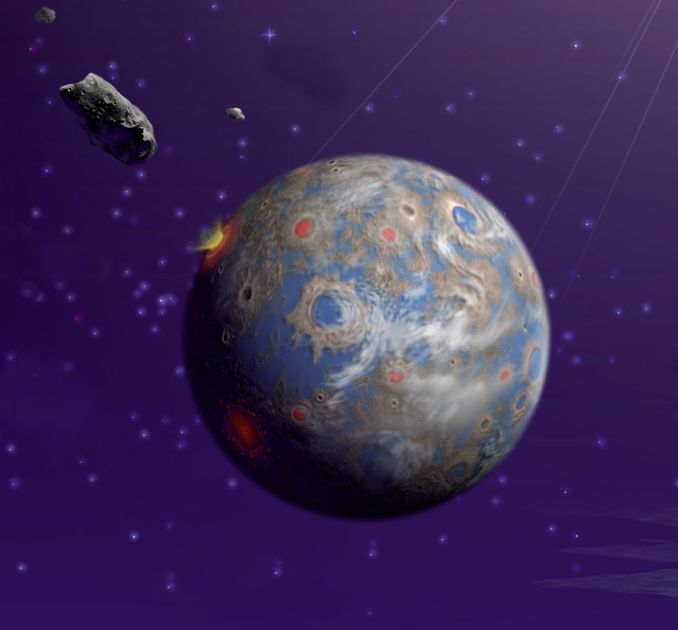
Life found on other planets or even
around other stars may be based
on similar (if spread by impacts
or interstellar dust) as well as
very different biochemical
processes (if developed solely
based on local conditions).
Breaking News
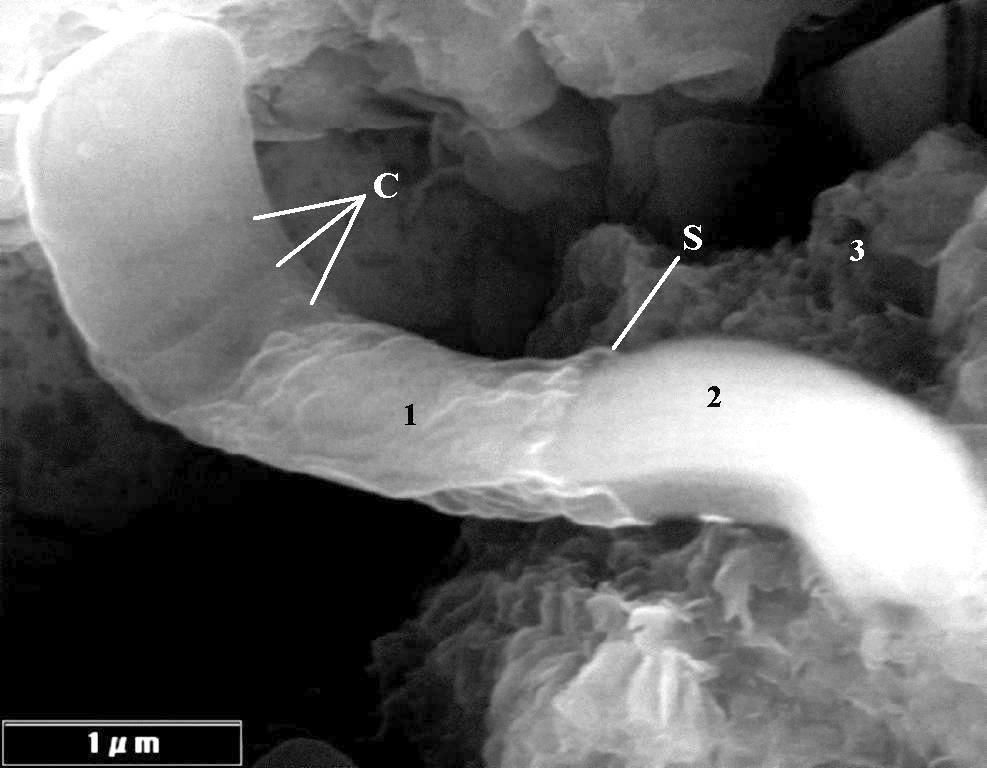
On March 4, 2011 in the Journal of Cosmology, Richard B. Hoover (a scientist working at NASA's Marshall Spaceflight Center) published his third controversial paper on new findings of potential fossilized bacteria, many similar to familiar and unknown Cyanobacteria and other trichomic prokaryotes such as filamentous sulfur bacteria that are missing amino acids found in similar, modern Earth bacteria, on freshly fractured inner surfaces of extremely rare but water-rich, carbonaceous meteorites ("CI1 carbonaceous chondrites") recovered from France, Antarctica, and Tanzania. Although the microstructures showed evidence of carbon, a potential marker for Earth-type life, there was almost no nitrogen, which could have decomposed into gas long ago. If the structures are confirmed as bacterial fossils, however, at least one commenting scientist (i.e., Patrick Godon) has argued that it is unclear whether ancient meteoric impacts on Earth may have contaminated some of the carbonaceous debris in space with bacteria that originally lived on Earth, as well as presumably Mars, Venus, or other planets, moons, or smaller asteroidal or cometary bodies. Regarding Hoover's decade-long investigation, another commenter and sometimes collaborator (Elena V. Pikuta) noted that hundreds of scientists (including experts in many fields) assisted or were consulted, that the Carbon-13 and Deuterium to Hydrogen content of amino acids and other organics in the meteorities examined are consistent with known cometary composition, and that some microstructures come from the Orgueil meteorite, which contain magnetites that have been dated to be 4.56 billion years old and so may be older than known life on Earth (Ferris Jabr, New Scientist, March 8, 2011, with more counter arguments; NASA amended statement of disavowal from SpaceRef; redOrbit staff and Reuters wire report by Deborah Zabarenko, redOrbit, March 7, 2011; Alan Boyle, MSNBC, March 6, 2011, and March 7, 2011; Richard B. Hoover, 2011 with more images, and commentaries; 2004; and 1997).
 Richard B. Hoover, 2011;
Journal of Cosmology
Richard B. Hoover, 2011;
Journal of Cosmology
Larger and
jumbo images of potential
fossilized
Cyanobacteria.
On March 4, 2011, a new paper described potential
fossilized bacteria (many similar to familiar and
unknown
Cyanobacteria)
in freshly made,
uncontaminated cracks within carbonaceous
meteorites found on Earth
(more).
What is life and did it develop elsewhere?
According to physicist and astrobiologist
Paul Davies, the
scientific community has not yet reached consensus on
a strict definition of life. Many biologists agree,
however, that living organisms should be able to do
the following: Order: Molecules in living things
are arranged in specific structures; Reproduction: Living things have
the ability to reproduce their own kind.
Simple life forms, such as bacteria, reproduce
by dividing and making almost exact replicas
of themselves. More complex organisms reproduce
sexually, so that their offspring have genetic
material from two individuals. Offspring with
traits from both parents have a greater chance
of survival because they are better able to
adapt. Growth and Development: Living
organisms grow and develop in patterns
determined by heredity, the traits passed
to offspring by parents. Energy Utilization: Living
things need to capture and use energy, a
process known as metabolism. An example
of such a process is photosynthesis,
whereby plants convert sunlight into
energy. Response to Stimuli: Living
organisms respond to changes in their
environment. Evolutionary Adaptation: Living
things evolve in such a way that future
generations are adapted to unique situations
in their surroundings. For example, the
hammerhead shark, considered to be perhaps
the most highly evolved species of shark,
has superior vision and sensory perception
due to its hammer-shaped head. Organisms
that cannot adapt to a changing environment
decline or become extinct.
NASA's Phoenix
Mars Mission (which will seek for organic evidence
of ancient or current Earth-type life down to three feet
below Mars' surface upon landing on May 25, 2008) argues
that life has
six
common properties:
Under these types of definitions,
viruses
(and
prions)
which rely on larger lifeforms to perform metabolism
and reproduction are
not
technically alive, but the status of
possible
nanobacteria (under 200
nanometers)
has yet to be resolved
(Caroline
Williams, New Scientist, November 19, 2010).
In recent years, the idea that life originating on one planetary body can somehow disperse through space to other planetary habitats has gained support. Within the Solar System, it is possible that life developed in the first accommodating habitat -- perhaps in the early days of a possbily watery Venus -- and was spread by the ejecta of asteroidal and cometary impacts to neighboring planets. Indeed, if some microscopic life can survive long passages through space (despite the cold, radiation, and vaccum), then perhaps Earth's lifeforms originally developed outside the Solar System. If that's true, then it's also possible that microbial life from our Solar System may have already spread to other star systems. It is also possible that alien microbes are falling through Earth's atmosphere every day but are not well adapted to common environmental niches and so do not compete very well for survival, except in biological niches less hospitable to native lifeforms. (More discussion at NASA and panspermia.org.)
 Cyanosite
-- NASA image of Chroococcidiopsis
Cyanosite
-- NASA image of Chroococcidiopsis
Dividing
Chroococcus
sp., a type of
Cyanobacteria,
photosynthetic microbes that also produce oxygen.
While "primitive,"
Chroococcidiopsis
survives in
extremely dry, cold, and salty environments -- even
potential
ejection from Mars without sporulation
(also
Horneck
et al, 2008).
It is possible that life on Earth has developed independently more than once, and that some lifeforms rely on biochemical processes different from those already known. It is also possible that these "exotic" lifeforms persist on Earth today. If so, they may be difficult to detect (Paul Davies, December 2007).
Biochemical Alternatives
Many biologists believe that all Earth lifeforms that have been studied in detail thus far almost certainly descended from a common origin. Apparently, organisms found thus far on Earth share a similar biochemistry and rely on a highly similar genetic code (relying on DNA, which possibly developed from RNA and even earlier precursors) which enables biologists to sequence their genes and position on a single tree of life. Some (including Paul Davies), however, argue that the procedures used to analyze newly discovered organisms are too customized to detected life as already known to biologists and so lifeforms relying on alternative biochemical processes may commonly exist but escape detection.
While most known Earth-type life depends
on five essential elements (carbon, hydrogen, oxygen, nitrogen,
sulfur, and phosphorus), alternative biochemistries may be possible,
including:
 Wolfe-Simon
et al, 2010;
Science,
AAAS
Wolfe-Simon
et al, 2010;
Science,
AAAS
Larger image.
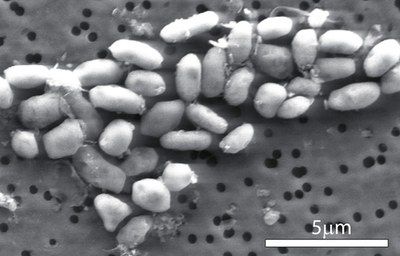
In 2010, scientists confirmed that at
least one type of bacteria
(GFAJ-1)
on Earth can survive on arsenic
instead of phosphorus
(more).
Other Information
Try the NASA Astrobiology Institute (NAI).
© 2007-2011 Sol Company. All Rights Reserved. |