Delta Pavonis

Delta Pavonis |
|
|
| Home | Stars | Habitability | Life | |
NASA
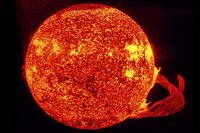
Delta Pavonis is a yellow-orange star
like our Sun, Sol. (A
2MASS
Survey
image
of Delta Pavonis at the
NASA
Star and Exoplanet Database.)
System Summary
This star is located about 19.9 light-years (ly) away from our Sun, Sol. It can be found near the center (20:08:43.61-66:10:55.45, ICRS 2000.0) of Constellation Pavo, the Peacock -- west of Beta Pavonis. Although smaller and dimmer than Sol, it is clearly visible with the naked eye.
 JPL,
CalTech,
NASA
JPL,
CalTech,
NASA
Larger illustration
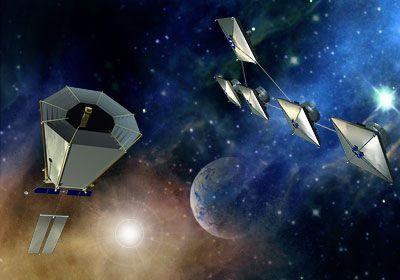
Astronomers have identified Delta
Pavonis as a prime target for the
Terrestrial
Planet Finder (TPF), and the
Space
Interferometry Mission (SIM),
now both indefinitely postponed.
Due to Delta Pavonis' relative proximity and similarity of spectral type to Sol, the star has been an object of intense interest among astronomers. Delta Pavonis became one of the top 100 target stars for NASA's proposed Terrestrial Planet Finder (TPF), but the project has been postponed indefinitely. It was also selected as a "Tier 1" target star for NASA's optical Space Interferometry Mission (SIM) to detect a planet as small as three Earth-masses within two AUs of its host star (and so some summary system information may still be available from the SIM Teams), but the SIM project manager announced on November 8, 2010 that the mission was indefinitely postponed due to withdrawal of NASA funding.
Delta Pavonis is a yellow-orange main sequence dwarf star of spectral and luminosity type G5-8 V-IV. This star has about 1.04 to 1.10 times Sol's mass (SIM; and RECONS), 1.06 times its diameter (Johnson and Wright, 1983, page 695), and about 1.18 times its luminosity. The star may be 95 percent to 2.7 times as enriched as Sol with elements heavier than hydrogen ("metallicity") based on its abundance of iron (Cayrel de Strobel et al, 1991, page 306), but although probably older than Sol, its exact age is uncertain (Harmer et al, 1970; and Alexander William Rodgers, 1969). Based on chromospheric activity and rotational period alone, Delta Pavonis could be around 6.6 and 6.9 billion years old (Mamajek et al, 2008, Table 13). It has a New Suspected Variable designation NSV 12790 and appears to be unusually bright for its spectral type, and so may be becoming a subgiant star that is beginning to evolve off the main sequence, as it begins to fuse the increasing amounts of helium "ash" mixed with hydrogen at its core. Useful star catalogue numbers for the star include: Del Pav, HR 7665, Gl 780, Hip 99240, HD 190248, CD-66 2367, CP(D)-66 3474, SAO 254733, FK5 754, LHS 485, LTT 7946, and LFT 1520.
Since Delta Pavonis is somewhat similar to our Sun, many speculate whether it might contain planets that harbor life. Although the NASA Star and Exoplanet Database does not yet provide information on Delta Pavonis' habitable zone, the distance from this star where a planet like Earth would have liquid water on its surface is around 1.08 AUs based on its visual luminosity -- between the orbital distances of Earth and Mars in the Solar System. At that distance from the star (assuming that Delta Pavonis has 1.1 Solar-masses), such a planet would have an orbital period of about 394 days, or 1.08 Earth years.
Hunt for Substellar Companions
Astronomers are hoping that they will eventually be able to use NASA's Terrestrial Planet Finder (TPF) and the ESA's Darwin planned groups of observatories to search for a rocky inner planet in the so-called "habitable zone" (HZ) around Upsilon Andromedae A. Now indefinitely postponed, the TPF would include two complementary observatory groups, a visible-light coronagraph and and a "formation-flying" infrared interferometer, while Darwin would launch a flotilla of three mid-infrared telescopes and a fourth communications hub.
Closest Neighbors
The following star systems are located within 10 light-years of Delta Pavonis.
------------------------------------- [Guide] -- [Full Near Star Map] -------------------------------------
| Star System | Spectra & Luminosity | Distance (light-years) |
| L 119-44 | M V | 5.8 |
| L 205-128 | M3.5-5 V | 6.4 |
| CD-45 13677 | M0 V | 7.3 |
| CD-49 13515 / Gl 832 | M1.5 V | 7.4 |
| Hip 82725 | ? | 7.5 |
| L 347-14 | M4.5 V | 7.7 |
| Epsilon Indi | K3-5 Ve | 9.2 |
| Beta Hydri | G2 IV | 9.3 |
| CD-46 11540 | M2.5-3 V | 9.9 |
| CD-44 11909 | M3.5-5 V | 10.0 |
Other Information
Up-to-date technical summaries on these stars can be found at: the Astronomiches Rechen-Institut at Heidelberg's ARICNS, the NASA Star and Exoplanet Database, the Research Consortium on Nearby Stars (RECONS) list of the 100 Nearest Star Systems, and the SIMBAD Astronomical Database. Additional information may be available at Roger Wilcox's Internet Stellar Database.
Observable only in the southern hemisphere, Constellation Pavo is located between Telescopium to the north and Octans to the south. For more information about the stars and objects in this constellation, go to Christine Kronberg's Pavo. For an illustration, see David Haworth's Pavo.
For more information about stars including spectral and luminosity class codes, go to ChView's webpage on The Stars of the Milky Way.
© 1998-2011 Sol Company. All Rights Reserved. |