Altair

Altair |
|
|
| Home | Stars | Habitability | Life | |
 © Norm Klekoda
(Dark Skies
Michigan;
used with permission)
Altair is the bright star at
left of the dark nebula.
(See a 2MASS Survey
image
of Altair from the
NASA
Star and Exoplanet
Database.)
System Summary
The name Altair is derived from the Arabic for "The Flying Eagle." The star is located about 16.7 light-years (ly) away from our Sun, Sol, in the north central part (19:50:47.00+08:52:05.96, ICRS 2000.0) of Constellation Aquila, the Eagle. Also called Alpha Aquilae, Altair is the brightest star in Aquila. It is also the lower left member of the "Summer Triangle" of first magnitude stars viewed from the northern hemisphere, formed with Vega (Alpha Lyrae) at the lower right, and Deneb (Alpha Cygni) at upper right. Altair is readily visible to the naked eye. With a telescope, an optical companion may be visible. (See Akira Fujii's color photo of Altair -- brightest bluish star at the top center of photo.)
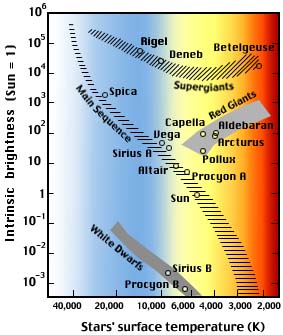
NASA Observatorium
See a discussion of
the
"main
sequence"
as part of
stellar
evolution and death.
The Star
Altair is a white main sequence dwarf star of spectral and luminosity type A7 V-IVn. According to various estimates, the star has about 1.7 times Sol's mass (RECONS), 1.8 times its equatorial diameter (JPL press release, 2001; T. Moon, 1985; Morossi and Malagnini, 1985, page 369; and Johnson and Wright, 1983, page 695), and about 10.7 times its visual luminosity and 9.845 its bolometric luminosity (NASA Star and Exoplanet Database, derived from of Kenneth R. Lang, 1980). Like Sirius, however, Altair radiates much more in ultraviolet wavelengths than Sol, and, not surprisingly, the European Space Agency has used ultraviolet spectral flux distribution data to determine stellar effective temperatures and surface gravities, including those of Altair.

Steve Golden/NASA/JPL/Caltech/Mount
Wilson Observatory
Altair is
14
percent wider than it is tall (see
video).
Based on Altair's abundance of iron, the star appears to be twice as enriched as Sol with elements heavier than hydrogen ("metallicity"), (Cayrel de Strobel et al, 1991, page 306). Not surprisingly, dust has been detected around this young star (Kuchner et al, 1998 -- in pdf). According to Holweger et al (1999), this dust disk may have developed after most of the surrounding nebulae of gas has been absorbed or expelled as a shell of gas from the developing star before it reached the main sequence.
Altair has the New Suspected Variable designation NSV 24910 and is unusually bright for its spectral type and so may be becoming a subgiant star that is beginning to evolve off the main sequence, as it begins to fuse the increasing amounts of helium "ash" mixed with hydrogen at its core. Although the star should be only a few hundred million years old, it is so much bigger and hotter than Sol that it will exhaust its core hydrogen around only a billion years and turn into a red giant or Cepheid variable before puffing away its outer layers to reveal a remnant core as a white dwarf.
 Ming
Zhao;
Monnier
et al, 2007;
Ming
Zhao;
Monnier
et al, 2007;
U. of Michigan
Larger composite image
(more).
Altair's flattened ellipsoid shape
has been directly imaged
(more).
Altair has one of the fastest known rotational speeds -- 210 kilometers per second (131 miles per second)-- and so completes at least one rotation in about 10.4 hours. By comparison, the rotational speed of Sol is only 25.4 days at its equator. As a result of the rapid spinning, the star probably has the shape of a flattened ellipsoid, where the equatorial diameter was estimated to be 14 percent greater than the polar diameter in 2001. Useful star catalogue numbers for Altair include: Alp or Alf Aql, 53 Aql, HR 7557, Gl 768, Hip 97649, HD 187642, BD+08 4236, SAO 125122, FK5 745, LHS 3490, LTT 15795, LFT 1499, and ADS 13009 A.
According to one type of model calculations performed for the NASA Star and Exoplanet Database, the inner edge of Altair's habitable zone is located relatively far from the star at around 2.177 AUs from the star, while the outer edge lies even farther out at around 4.475 AUs. The distance from Altair where an Earth-type planet would be "comfortable" with liquid water is centered around 3.3 AUs -- at the outer reaches of the Main Asteroid Belt's orbital distance in the Solar System. At that distance from the star, such a planet would have an orbital period of around 4.7 Earth years. If there is life on any Earth-type planet orbiting youthful Altair, it is likely to be primitive single-cell, anaerobic (non-oxygen producing) bacteria under constant bombardment by meteorites and comets as Earth was for the first billion years. Since there is unlikely to be free oxygen in the atmosphere of such a planet, it probably would not have an ozone layer (O3) although Altair puts out a lot more hard radiation (especially ultraviolet) than Sol.
Hunt for Substellar Companions
A search for faint companions using the Hubble Space Telescope from 1995 to 199 found no supporting evidence for a large Jupiter or brown dwarf sized object (Schroeder et al, 2000). On the other hand, the failure to find large substellar objects like brown dwarfs or a Jupiter- or Saturn-class planet in a "torch" orbit (closer than the Mercury to Sun distance) around Altair -- with even the highly effective radial-velocity methods of Geoff Marcy and Paul Butler -- bodes well for the possibility of Earth-type terrestrial planets around this star.Closest Neighbors
The following star systems are located within 10 light-years of Altair.
------------------------------------- [Guide] -- [Full Near Star Map] -------------------------------------
| Star System | Spectra & Luminosity | Distance (light-years) |
| Ross 652 A
Van Biesbroeck's | M3.5 Ve M8 Ve | 3.7 |
| 70 Ophiuchi 2? | K0-1 Ve K5-6 Ve | 7.8 |
| Hip 103039 | ? | 9.1 |
| 61 Cygni AB | K3.5-5 Ve K4.7-7 Ve | 9.8 |
| V1581 Cygni 2 | M5.5 Ve M6V | 9.8 |
| AC+17 534-105 | M3.5 Ve | 10.0 |
Other Information
Try Professor Jim Kaler's Stars site for other information about Altair at the University of Illinois' Department of Astronomy.
Up-to-date technical summaries on these stars can be found at: the Astronomiches Rechen-Institut at Heidelberg's ARICNS, the NASA Star and Exoplanet Database, and the Research Consortium on Nearby Stars (RECONS) list of the 100 Nearest Star Systems. Additional information may be available at Roger Wilcox's Internet Stellar Database.
Located at the celestial equator, Constellation Aquila, the Eagle, and Constellation Cygnus, the Swan, were hunted by Hercules. Along with a third, the Vulture (renamed in later as Constellation Lyra, the Lyre), the birds comprised one of the tasks (the Stymphalian Birds) of Hercules. For more information about the stars and objects in this constellation and an illustration, go to Christine Kronberg's Aquila. Another illustration is available at David Haworth's Aquila.
For more information about stars including spectral and luminosity class codes, go to ChView's webpage on The Stars of the Milky Way.
© 1998-2011 Sol Company. All Rights Reserved. |